Announcing! St. Mary’s Women of Faith Fall Study

Catholicism –  A Journey to the Heart of the Faith-a Multimedia Program by Bishop Robert Barron

All Women are welcome.  We will gather to grow in our faith and community while we learn and share together.

❤️  The Beatitudes and Parables 

❤️  Arguments for God’s Existence

❤️    Mary, The Mother of God 

❤️  Peter, Paul, and the Missionary Adventure

❤️  The Mystical Union of Christ and the Church

❤️ The Mystery of the Liturgy and the Eucharist

❤️  The Saints

❤️  Prayer and the Life of the Spirit 

❤️   Death, Judgment, Heaven, and Hell

This study is free to you – there is no book purchase required to join.

Meetings are in St Joseph’s Hall at St, Mary’s Church. Enter through the church parking lot located behind the church and through the back door.

Contact:  Patty Price pprice1641@gmail.com  717- 274-2007 

Jane Kreider janekreider925@gmail.com 717-507-0186

More information will also be available in the narthex.  To register –Online below ⬇️, Email, text, or drop form in the provided box.

Registration for the Fall Women of Faith Study Group

Registration is free and there is no book to purchase.

This field is for validation purposes and should be left unchanged.
Name

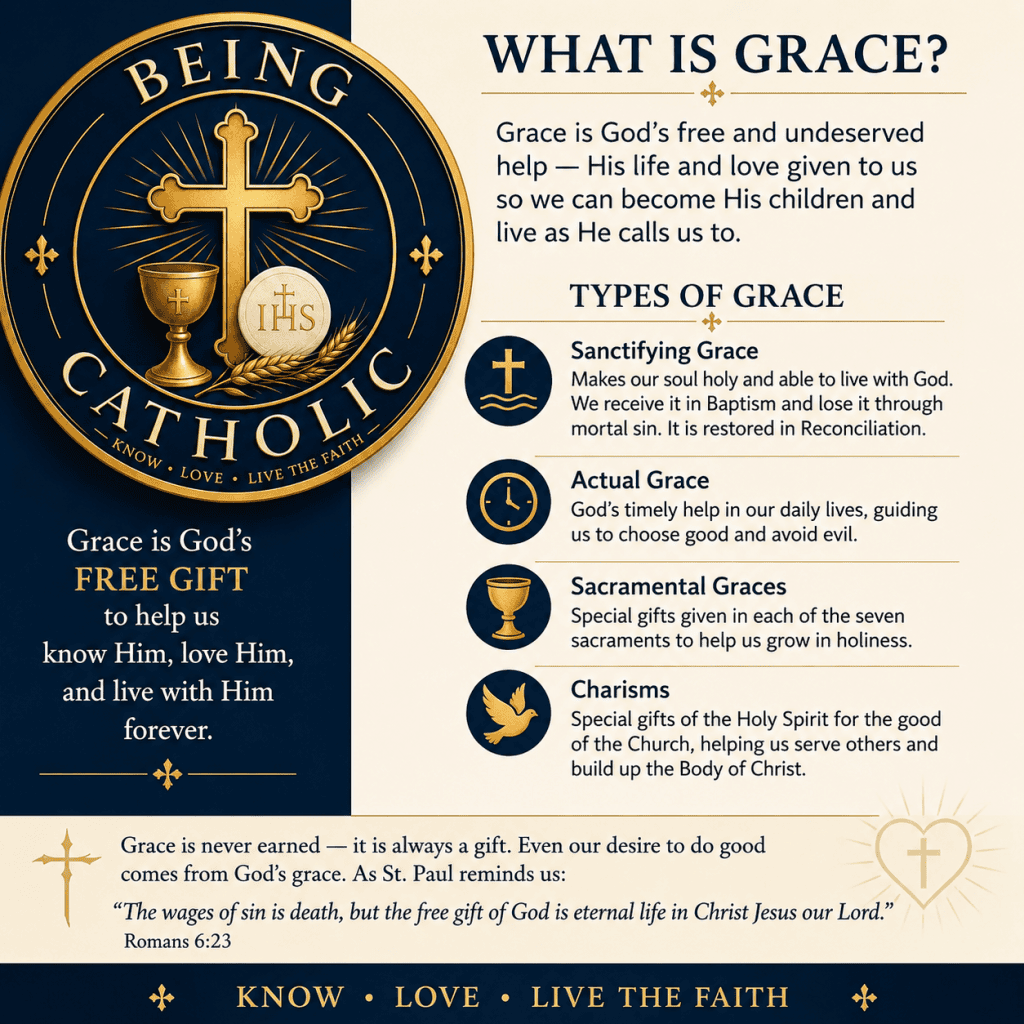
What is Grace?

The Catechism describes grace as the “free and undeserved help that God gives us to respond to His call” (CCC 1996). Through grace, God shares His divine life with us and gives us the help we need to grow in holiness.

The Church helps us understand grace in several ways:

Sanctifying Grace is the gift of God’s own life within our souls. We first receive sanctifying grace in Baptism. It is lost through mortal sin and restored through the Sacrament of Reconciliation.

Actual Grace is God’s help at particular moments in our lives. It may prompt us to do something good, resist temptation, forgive someone, pray, or turn back toward God.

Sacramental Graces are special gifts associated with each of the seven Sacraments, helping us live out the purpose of that Sacrament.

Charisms are special graces of the Holy Spirit given for the good of others and the building up of the Church. These may include gifts for teaching, service, leadership, encouragement, or other ways of serving the Body of Christ.

Grace Is a Gift

We do not earn God’s grace. We cannot purchase it or make God owe it to us. Grace begins with God. Even our desire to turn toward Him and do what is good is made possible by His grace.

Yet God does not force us. He gives us the freedom to respond to His grace and cooperate with it.

That means grace is not simply something we receive at Baptism and never think about again. God’s grace is at work throughout the Christian life—calling us, strengthening us, forgiving us, and helping us become the people He created us to be.

“The wages of sin is death, but the free gift of God is eternal life in Christ Jesus our Lord.” — Romans 6:23

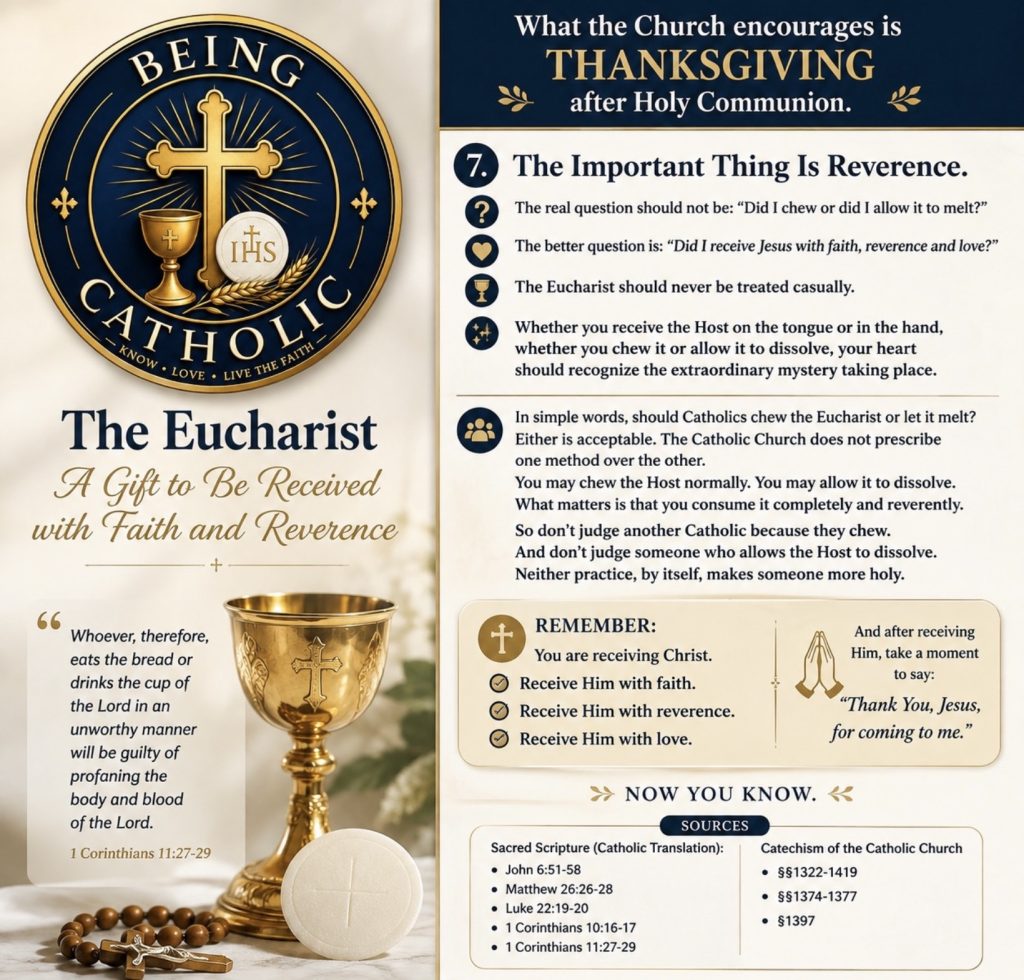
Is it Ok to Chew the Eucharist?

What Catholics Should Know About Receiving the Eucharist

Whether you receive the Host on the tongue or in the hand, whether you chew it or allow it to dissolve, your heart should recognize the extraordinary mystery taking place.

The real question should not be: “Did I chew or did I allow it to melt?”
The better question is: “Did I receive Jesus understanding that this is the real presence of Jesus…., body, soul and divinity?

Jesus is fully present under the appearance of simple bread and wine so should never be treated casually.
Whether you receive the Host on the tongue or in the hand, whether you chew it or allow it to dissolve, your heart should recognize the extraordinary mystery taking place.

The Catholic Church does not prescribe one method over the other. Neither practice, by itself, makes someone more holy.

You are receiving Christ.
Receive Him with faith.
Receive Him with reverence.
Receive Him with love.

“May this Holy Communion bring about a perfect union with You, the one true God, and at last enable me to reach eternal bliss when You will call me.” ST. THOMAS AQUINAS

Screenshot

Women Sharing Faith at Our Lady of Fatima in Jonestown 9/19

Women Sharing Faith at Our Lady of Fatima 💙

Starting this September 19th , women of all ages are invited to come together at Our Lady of Fatima on the first and third Saturdays of each month for prayer, learning, conversation, and friendship.

This year, the group will journey through Mary: A Biblical Walk with the Blessed Mother, exploring Mary’s life through Scripture and growing in our understanding of her unique role in God’s plan.

Whether you are a longtime participant or have never attended before, you are warmly invited to join us.

Saints, Prayers and Intercession

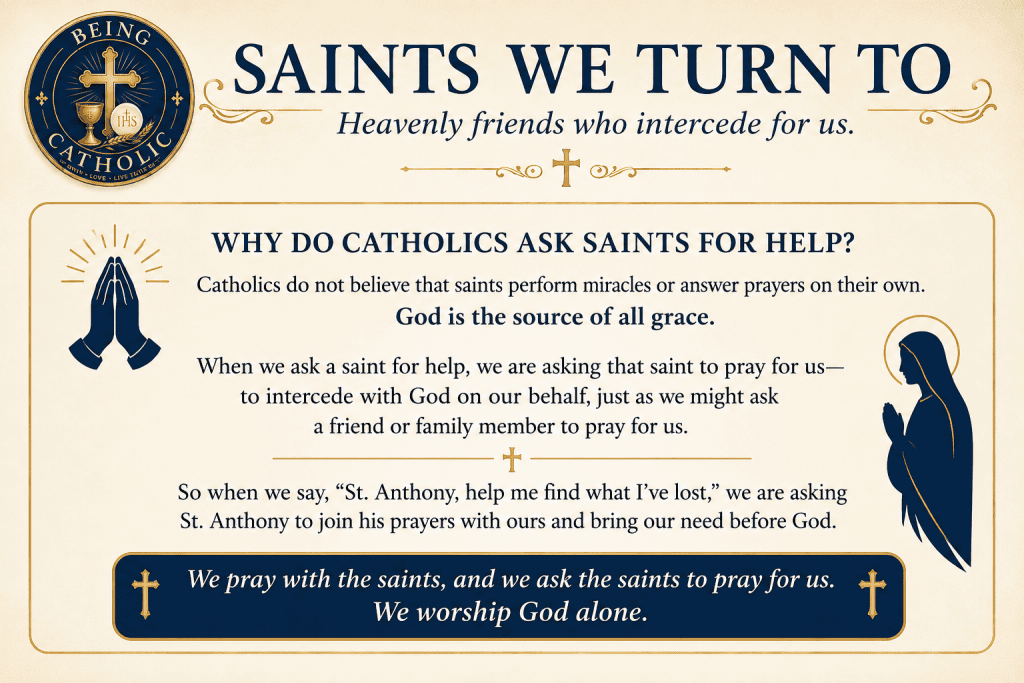
Why Do Catholics Ask Saints for Help?

Catholics do not believe that saints perform miracles or answer prayers on their own. God is the source of all grace.

When we ask a saint for help, we are asking that saint to pray for us—to intercede with God on our behalf, just as we might ask a friend or family member to pray for us.

So when we say, “St. Anthony, help me find what I’ve lost,” we are asking St. Anthony to join his prayers with ours and bring our need before God.

We pray with the saints, and we ask the saints to pray for us. We worship God alone.

Which saint do Catholics traditionally turn to for…?”

Here are some of the most familiar ones:

Here are some of the most familiar ones:

  • St. Anthony of Padua — lost things
  • St. Christopher — travelers and safe travel
  • St. Joseph — workers, fathers, families, and a happy death
  • St. Jude — desperate or seemingly hopeless causes
  • St. Francis of Assisi — animals and care for creation
  • St. Thérèse of Lisieux — everyday needs; doing small things with great love
  • St. Michael the Archangel — protection against evil
  • St. Peregrine — people with cancer and serious illness
  • St. Padre Pio — healing, suffering, and difficult illnesses
  • St. Dymphna — people experiencing mental or emotional suffering
  • St. Monica — children and loved ones who have fallen away from the faith
  • St. Gerard Majella — expectant mothers, pregnancy, and childbirth
  • St. Anne — mothers, grandmothers, and families
  • St. Valentine — engaged couples and happy marriages
  • St. Cecilia — musicians and singers
  • St. Francis de Sales — writers and journalists
  • St. Isidore the Farmer — farmers and agricultural workers
  • St. Florian — firefighters
  • St. Luke — physicians and healthcare workers
  • St. Matthew — accountants, bankers, and financial workers
  • St. Joseph of Cupertino — students taking exams
  • St. Blaise — ailments of the throat
  • St. Lucy — eyesight and people with eye problems
  • St. Nicholas — children
  • St. Rita of Cascia — difficult and seemingly impossible situations

My Catholic Home

What did we miss?

This field is for validation purposes and should be left unchanged.

Do You Want to Become Catholic?

Interested in Becoming Catholic? ✝️

Have you been thinking about becoming Catholic—or completing the Sacraments you began earlier in life?

St. Mary’s offers OCIA (formerly RCIA) for adults who are:
• Seeking Baptism
• Already baptized in another Christian tradition and interested in becoming Catholic
• Baptized Catholic but wishing to complete their Sacraments of Initiation

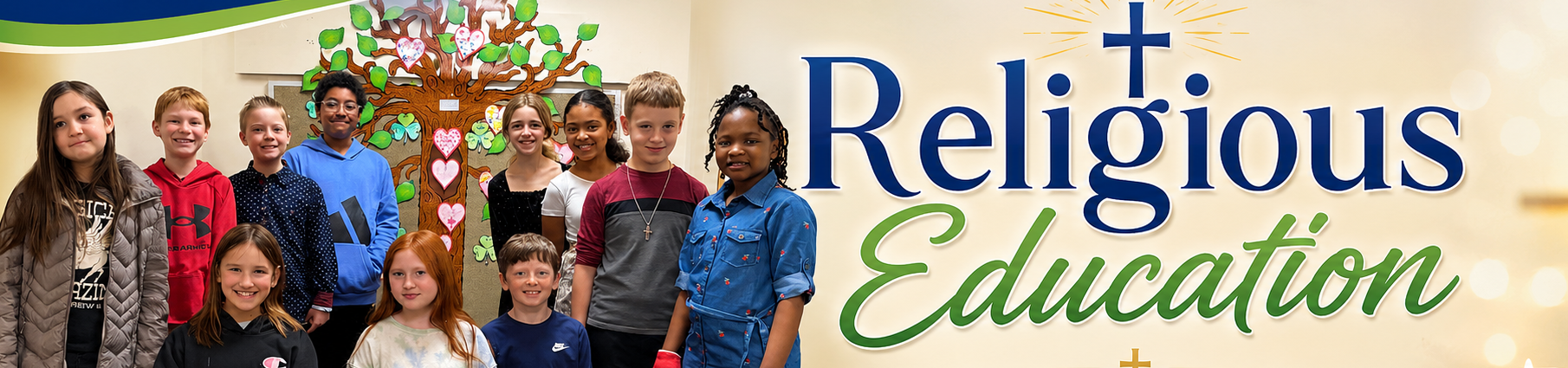
We also offer Religious Education for children and young people, helping prepare them for the Sacraments, including First Holy Communion and Confirmation, while growing in their understanding of Scripture, prayer, and our Catholic faith.

Perhaps you’ve been thinking about it for a while. This may be the time to take that next step.

For information or to ask questions, please contact our Director of Religious Education through the parish office at 717-272-5674.

Please share this post—you never know who may be waiting for an invitation. ❤️

Remembering Loved Ones at St. Mary’s and Fatima

Remembering and Praying for Our Dead 🕯️

As Catholics, we don’t simply remember those we love who have died—we pray for them. Here at St. Mary’s and Our Lady of Fatima Mission, there are many beautiful ways we pray for our faithful departed, honor their memory, and entrust them to the mercy of God.

🙏 Have a Mass offered for a loved one.
Mass intention cards are available through the parish office. The names of those for whom the Mass is offered are published in the bulletin and remembered at Mass.

⚰️ Celebrate the Catholic Funeral Rites.
When a loved one dies, the Church accompanies the deceased and the grieving family with prayer. The Funeral Mass commends the deceased to God’s mercy and offers the Eucharistic sacrifice for his or her soul. At the cemetery, the Rite of Committal provides the Church’s final prayers as the body is laid to rest in the hope of the resurrection.

🍽️ Gather for a funeral luncheon at St. Mary’s.
Following a funeral, St. Mary’s offers a luncheon for the family and friends of the deceased in Frederick Hall. Parish volunteers lovingly prepare and serve the meal, set beautiful tables, and take care of the cleanup, allowing the family time to gather and share memories after saying goodbye to their loved one. There is no charge for the luncheon. Families may make a voluntary offering if they wish and are able.

It is another beautiful way our parish community surrounds a grieving family with faith, compassion, and loving service during a difficult time.

🕯️ Light a candle in prayer.
Candles may be lit in remembrance of loved ones. See one of our ushers before or after Mass for assistance.

❤️ Attend our November Remembrance Mass.
Each November, St. Mary’s celebrates a special Mass of Remembrance. The names of parishioners who have died during the previous year are read aloud as we remember them in prayer.

📖 Remember our loved ones in the Book of the Names of the Dead.
During November, our Book of the Names of the Dead, also known as the Book of Remembrance, is placed in a place of honor in the church. The book is maintained and kept up to date by our parish secretary, preserving the names of our faithful departed as we remember them in prayer throughout the month.

⛳ Honor someone through the Charles and Susie Middleton Golf Tournament.
Deceased loved ones may also be honored through sponsorship of our parish golf tournament, with their names included among those remembered.

🕯️ Dedicate the Sanctuary Candle.
Parishioners may request that the Sanctuary Candle burn in remembrance of a deceased loved one. These intentions are published in the bulletin. Sanctuary Candle memorials are available at both St. Mary’s and Our Lady of Fatima Mission.

✝️ And at every Mass, we pray for the dead.
During the Eucharistic Prayer, the Church specifically remembers those who have died and asks God to welcome them into the light of His presence.

These aren’t simply traditions. They are expressions of one of the beautiful truths of our Catholic faith:

Our love and our prayers do not end at the grave.

Eternal rest grant unto them, O Lord,
and let perpetual light shine upon them.
May their souls and the souls of all the faithful departed,
through the mercy of God, rest in peace. Amen.

Ah, Catholics Live Here!

If Someone Walked Into Your Home, Could They Tell You’re Catholic?

There isn’t a required checklist for a Catholic home, of course. But traditionally, Catholic homes often contain visible reminders that this home belongs to Christ.

Things you might find include:

  • ✝️ A crucifix — often prominently displayed, especially in bedrooms or a main living area.
  • 🕯️ A prayer space — perhaps a small table or shelf with a crucifix, candle, Bible, holy cards, or statues.
  • 📖 A Catholic Bible
  • 📿 Rosaries — on a bedside table, near a favorite chair, or in a prayer area.
  • 💧 Holy water — sometimes kept near the entrance or in a small holy-water font.
  • 🌿 Blessed palms from Palm Sunday — traditionally placed behind a crucifix or religious image.
  • 🖼️ Sacred images — Jesus, the Sacred Heart, Divine Mercy, the Blessed Mother, the Holy Family, or favorite saints.
  • 🕊️ Statues of Mary or the saints.
  • 🕯️ Blessed candles — especially candles blessed at Candlemas.
  • 🏠 A house blessing — some families have their home blessed by a priest or deacon.
  • 🚪 Epiphany chalk blessing over the doorway — the traditional inscription such as 20 + C + M + B + 26.
  • 🌾 Sacramentals and blessed objects — medals, scapulars, crosses, holy cards, relics, or other devotional items.
  • 📚 Catholic books, prayer books, or a Catechism.
  • 🕯️ Reminders of loved ones who have died — memorial cards or photographs that encourage prayers for the deceased.
  • 🍽️ Faith at the dinner table — perhaps a crucifix nearby and, most importantly, the practice of saying grace before meals.
  • 🌟 Display a Nativity scene (crèche) at Christmas — Place a crèche in a prominent place in the home as a reminder that Christmas celebrates the birth of Jesus Christ. Some families wait until Christmas Eve to place the Christ Child in the manger.
  • 🕯️ Use an Advent wreath — Light the candles throughout Advent as the family prayerfully prepares for the coming of Christ.
  • 📿 Keep rosaries visible — Rosaries may hang from a bedpost, rest beside a favorite chair, sit on a prayer table, or be displayed near a crucifix or statue. Keeping them visible reminds us that the Rosary is meant not simply to be owned, but to be prayed.
  • 📅 Display a Catholic calendar — A Catholic calendar keeps the rhythm of the Church year visible in the home, marking feast days, solemnities, saints’ days, and liturgical seasons throughout the year.
    🌹 Create a Mary Garden — Dedicate a small flower garden or outdoor space to the Blessed Mother. Place a statue of Mary among the flowers and use the space as a quiet reminder to pray.

A Catholic home isn’t Catholic simply because it contains Catholic things.

The crucifix, rosary, holy water, sacred images, and blessed objects are sacramentals—visible reminders that help turn our hearts toward God.

The greatest sign of a Catholic home is the faith that is lived inside it.

What Catholic things or traditions are found in YOUR home? What did we miss?

My Catholic Home

What did we miss?

This field is for validation purposes and should be left unchanged.