“Looking for older homilies? Visit our Printable Homily Page.”
👉🏼https://abvmlebpa.org/6173-2/
Share Christ’s Light
Reverend Robert Gillelan
World Mission Sunday • October 18, 2026
Matthew 22: 15-21
Today we celebrate World Mission Sunday, which is the one Sunday out of the year when we dedicate ourselves to praying for the Church’s missionary efforts around the world, and we support them financially. So there’s just one collection today: you do have a missionary appeal envelope in your packet of envelopes, so if you brought that today, just throw that in with your other $500 that you donated to St. Mary’s Church. If you forgot or you’re not prepared, you really do want to donate to the missions, but not today you can still donate.
Even if you don’t have a missionary appeal envelope, next week you can write a check to Saint Mary’s and put on the memo line “mission” or “mission appeal,” or just put some cash in an envelope and mark it “mission” or “missionary appeal.” We’ll make sure it gets to the missions.
So, we recognize that the Church has this missionary character about it, and it always has, and it always will, and something we forget is that we are also a part of that missionary effort. Those of you who are old enough, you remember the Latin dismissal at Mass: “Ite, missa est.” Deo gratias was the response.
Thanks be to God. “Ite, missa est”—“go, you are sent.” Response? Deo gratias.
Thanks be to God. We are thanking God for sending us out into the mission field to do what? Well, as Pope Leo XIV says, to make Christ’s love visible in our world. Or another way of saying it is to share the light of Christ.
But if you’re older like me, you may have grown up in a church that didn’t so much proclaim the love of Christ. Often we proclaim the law, the rules, the precepts, the commandments.
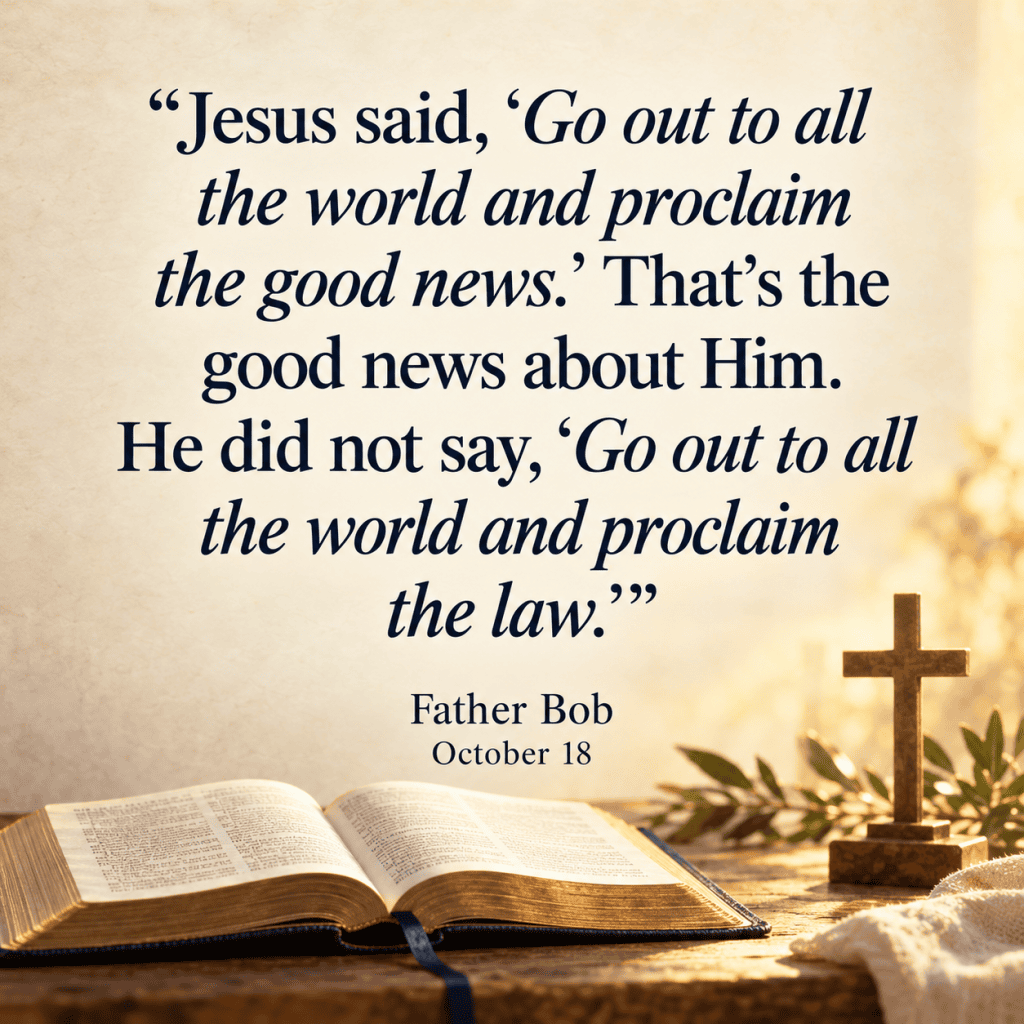
When you think about it, Jesus said, “Go out to all the world and proclaim the good news.” That’s the good news about Him. He did not say, “Go out to all the world and proclaim the law.”
These are a few examples. So, you know, back in the day, if somebody would have asked us, “Why do you go to Mass?” we very well might have said, “Well, because it’s a commandment.” It’s the third commandment.
It’s an obligation as a Catholic.
That’s all true, but is it the best answer? Or, “Why do you go to confession?” Well, because if I die with a mortal sin on my soul, I’m going to go to hell.
I fear the fires of hell. Well, that too may be true, but how attractive is that to someone who may be inquiring about our faith, about our religion?
Or, “Why do Catholics abstain from meat on Fridays in Lent?” Well, because it’s a rule. You know, that’s what a good Catholic would say, right?
Back in the day. Or, “Why do you put money in a collection basket?” Because it’s one of the five precepts of the Church.
I mean, in their own way, those are all correct answers, but in their own way, they’re still all wrong answers as well. Nobody joins any institution or any group because of its rules or its law.
No one joins a sports team because of its rules. No one joins a country club because of its bylaws.
And certainly no one joins a religion or church because of its laws. You would never say to someone inquiring about the Catholic Church, “You should join us. We have 1,752 laws in our code of canon law.” You would never say that. So, let’s understand the part that we should be saying out loud, and that’s the part that’s in our hearts, but it’s the part that we often don’t say.
We need to say these things out loud. So, “Why do you go to Mass?” Because I love the Lord, and I want to give Him praise and thanksgiving for the gift of salvation in Jesus Christ.
“Why do you go to confession?” I go to confession because I love the Lord, and I want to ask His forgiveness for my sins and try again, with the help of His grace, to live in His grace and friendship.
And, “Why do we abstain from meat on Fridays in Lent?” Yes, it is a rule, but I do it because I love the Lord, and my small sacrifice reminds me of our Lord’s great sacrifice on the cross.
And, “Why do you put money in the collection basket?” Yes, it is a precept of the Catholic Church.
But why do you do it? Why do we do it?
Because we love the Lord, and we want to support His mission within the Church and in the world. When we speak like that, we are proclaiming Christ.
We are proclaiming His goodness to us and our loving response. Those are the things that we need to learn to say out loud, to be credible in this world, and to really, I think, share the light of Christ and make His love visible in our world today.
Remembering what Jesus said, “Go out to all the world and proclaim the good news.” He never said, “Go out to all the world and proclaim the law.” So, today, as we celebrate World Mission Sunday, thank you for your support for the missions worldwide, remembering that our missionaries have carried the Catholic faith to every continent on Earth.
Let’s continue to pray for their efforts as they share the light of Christ and make His love visible in our world. Thank you for your generosity in supporting their mission, and that we also support them by embracing our missionary vocation to “Ite, missa est”—“go, we are sent”—that we too may share the light of Christ and make His love visible in our world by all that we share, and say, and do.
May the Holy Spirit help us to do that with deepest love, courage, and clarity.
Freedom in Christ
October 13, 2026
Reverend Robert Gillelan
In the readings today, Paul and Jesus are speaking about freedom from the law and freedom in Christ: to be free from the bondage of the law, to be free in the person of our Savior Jesus Christ.
And this is how the Catholic Church defines freedom in Christ. It is from the Catechism.
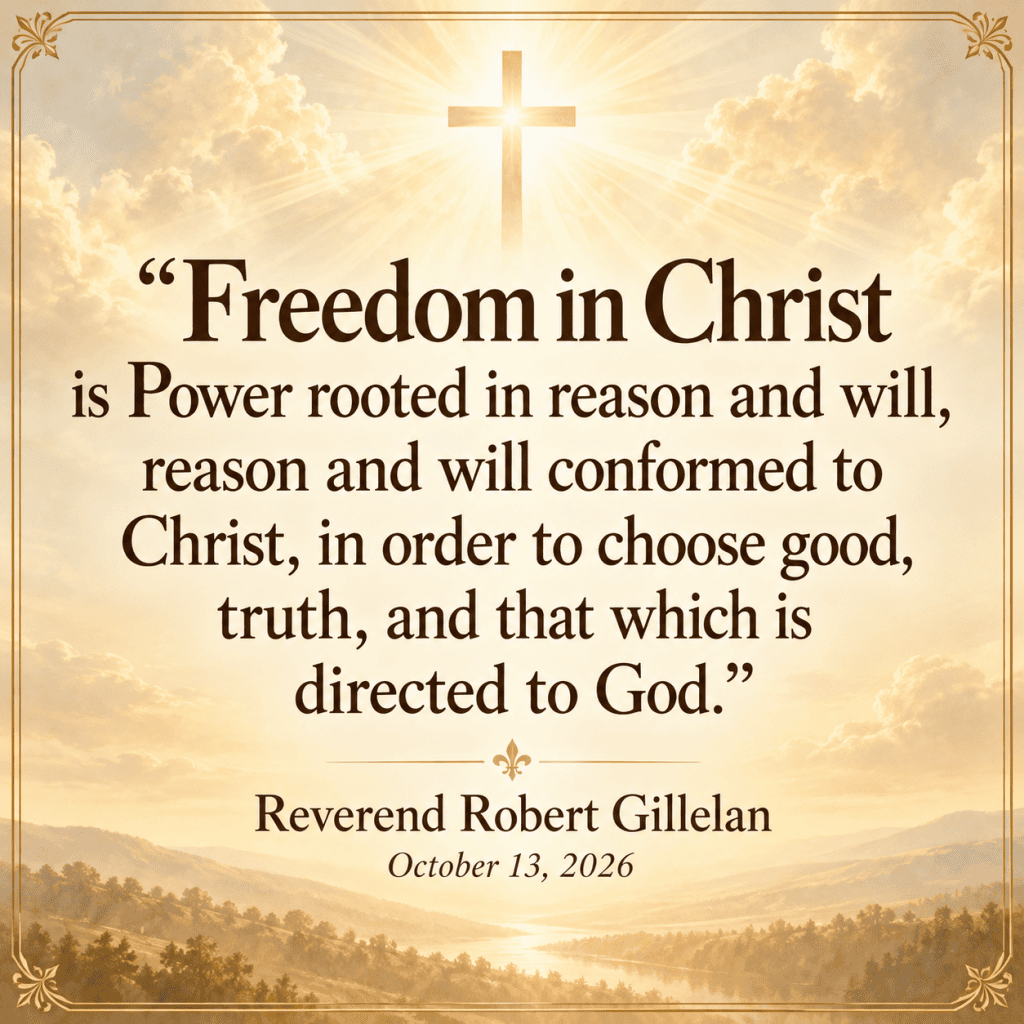
Freedom in Christ is power rooted in reason and will—and there, I’m going to add a parenthesis—conformed to Christ. Power rooted in reason and will, reason and will conformed to Christ, in order to choose good, truth, and that which is directed to God.
So again, freedom is the power we have, rooted in reason and will, conformed to Christ, to choose that which is good and true and directed to God.
And the bad news is, it’s often a lifelong struggle to attain that freedom.
That’s part of our quest for holiness, because there’s so many things that can compromise our freedom in Christ.
Sin.
You know, oftentimes we have to fight these lifelong battles because there are certain sins that rule our lives and hold us in bondage.
You know, from early years, we can grow up being prideful and self-righteous and impatient or jealous. And that compromises—those kinds of sins compromise—our freedom in Christ and our ability, our power, to do what is good and true and directed towards God.
Addiction can really compromise our freedom in Christ because it binds us. It binds us to something that is physically and spiritually unhealthy for us.
Physical and mental illness compromise our freedom in Christ.
Fear compromises our freedom in Christ. And that runs from the sublime to the ridiculous.
There’s fear of death and fear of not getting likes on Facebook.
All of those kinds of fears compromise our freedom in Christ, which is why Jesus said that we need perfect love to cast out fear.
Bad catechesis.
Shame on Holy Mother Church for not teaching us well over these past 75 years.
Many of us grew up in a Church that said a good Catholic was a Catholic that keeps all the rules. And that’s exactly what Jesus and Saint Paul are saying is not a good Catholic.
A good Catholic is someone who intentionally tries to follow Jesus Christ.
And of course, then, hardships in life, everyday hardships, can compromise our freedom to be with Christ and to choose what is good and true, directed towards God.
Say that, you know, we’ve got the great example of Saint Maximilian Kolbe.
So somebody said, well, he wasn’t free at all because he was imprisoned in Auschwitz.
But we see how he exercised, in his imprisonment, his freedom in Christ by exercising his power, his reason and his will, to choose what was good and true, directed towards God, by following the commandment or example of Jesus to lay down his life for another.
So even in life, when we undergo hardships and we don’t think that we have choices or much freedom, no one can take away from us our freedom in Christ.
So how do we know when we have that freedom?
I think in our spiritual lives, signs that we are living in that freedom that Christ wants us to have is when our lives are grounded in Christ in a way that gives our lives meaning and direction.
When our lives are filled with a kind of stability and peace, not regarding external circumstances, but feeling a deep-down rootedness and peace and joy.
So let us pray today that through Saint Paul and our Lord’s words to us, that we will take to heart that as we strive for holiness, what we are striving for is really freedom in Christ.
Through the grace of this sacrament, may the Lord help us to experience that freedom and to experience it in the full.
Transcript of Judgment Trilogy
Created on October 11, 2026
Reverend Robert Gillelan
We have the series , three gospel parables that are called the Judgment Trilogy. These are three parables that Jesus directed towards the chief priests and the elders of the people.
And the context is Palm Sunday: Jesus has just entered into Jerusalem to begin His saving work, and the chief priests and the elders of the people oppose His authority. They question Him.
So Jesus fires off three parables in judgment against them. So let’s go back two weeks and remember that first parable.
That was about the two sons, the obedient son and the disobedient son. Jesus compared the chief priests and the elders of the people to the disobedient son, the one who said he would go but never went to work in the vineyard.
And Jesus said to them, “Tax collectors and prostitutes are entering the kingdom of heaven before you.” Absolutely unthinkable in the minds of the chief priests and the elders of the people. However, the tax collectors and the prostitutes listened to the preaching of John the Baptist, and they converted. They came to believe in Jesus and changed their lives. Not so the chief priests and the elders of the people.
Then if we go back to last week, the parable of the bad tenants. Jesus compared the chief priests and the elders of the people to the bad tenants, the ones who abused the servants and eventually killed the son of the owner, which is all a metaphor for the way that the Jewish ancestors treated the prophets.
It is prophetic in the sense that the chief priests and the elders of the people will be complicit in killing Jesus. And so Jesus said to them, “The kingdom of God will be taken from you and given to people who will produce its fruit.”
Then we have today’s parable. Jesus compared the chief priests and the elders of the people to the guy who got thrown out of the wedding banquet. The wedding banquet being a metaphor for the kingdom of God.
He is thrown out because he does not have the right disposition of faith. He believes that he can go in there and stay there on his own terms. Jesus says that’s not the way it works.
And so consider these three parables and how there’s kind of an escalation in the urgency and the warning that Jesus gives to the chief priests and the elders of the people.
In the first parable, he’s really giving them a warning that they’re going to be excluded from the kingdom of God if they do not accept Jesus and His teachings. So there’s a warning regarding exclusion.
And then he ups the ante in the second parable, where he says, “If you don’t change, you will lose the kingdom of heaven. You will lose that and I will give it to others who will bear its fruit.” Finally he says, “You will be punished.” And Jesus says that very clearly. It’s one of His 16 references in the four gospels to hell, when the guy is thrown out into the darkness where there will be wailing and gnashing of teeth. That is a reference to what will happen to the chief priests and the elders of the people if they continue to oppose Jesus and His kingdom values.
So while that is, you know, in the history of salvation very specific to Jesus and His interaction with these Jewish leaders, we know that every parable has a powerful message for us. Because every parable tells us something about the nature of God, the nature of God’s kingdom, and the nature of responsibility in that kingdom.
I think we can see today that there are still those who, in a very dangerous spiritual way, continue to oppose Jesus and His kingdom. They continue to oppose and reject our Lord’s authority.
Take for example California. California just passed a law, Assembly Bill 1803, which says that every employer with 5 employees or more must institute anti-hate speech instruction. That sounds like a good idea, doesn’t it? Except there are many Catholic parishes in California who have 5 or more employees. And who gets to define hate speech? Sacramento.
So when a priest or a deacon or a parish employee happens to say, “God made them male and female,” quoting the book of Genesis, and someone is offended, let the lawsuits begin.
Last night, after the 5:30 mass, our parishioners left, and they were greeted by two men standing out here who were harassing and intimidating them, calling us idolaters.
Of course, the month before, our historic statue of Mary was desecrated. And over all of that, you know, we listen to the warnings of Bishop Barron, who reminds us that there are those today, individuals and groups, who try to insert their woke ideologies into our Catholic theology, trying to take the kingdom of God by force, to use the words of Jesus.
And so all of that is to say that there continues to be rejection and opposition and indifference and even violent opposition to Christ and His teachings and His kingdom today.
That’s the reality in which we live today. And even here in our small community of Lebanon, we experience it.
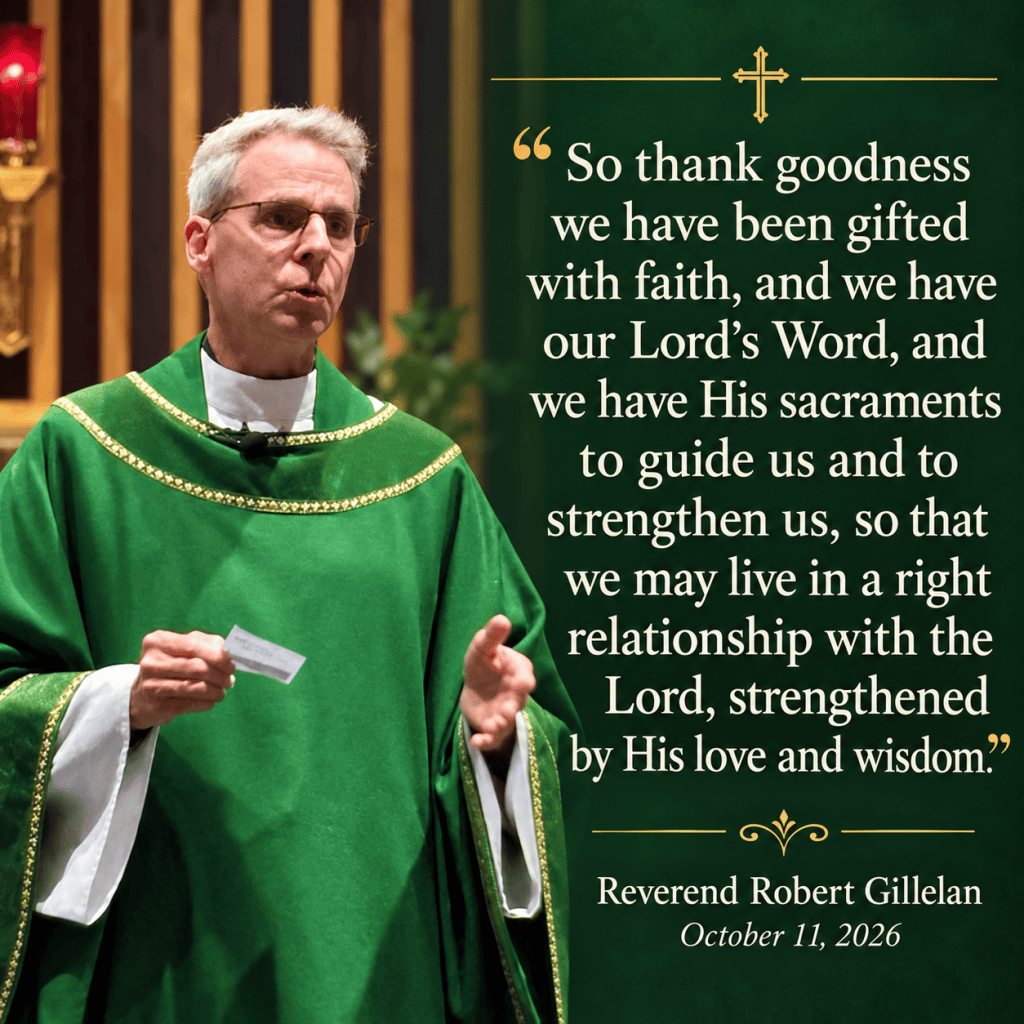
So thank goodness we have been gifted with faith, and we have our Lord’s Word, and we have His sacraments to guide us and to strengthen us, so that we may live in a right relationship with the Lord, strengthened by His love and wisdom. That our faith may be humble and may be strong, and that we may never lack the proper disposition of faith that we need to enter fully into His kingdom.
As we remember those immortal words of Jesus, who said, “Many are invited, but few are chosen.” May we humbly ask the Lord to count us among the few and the chosen.
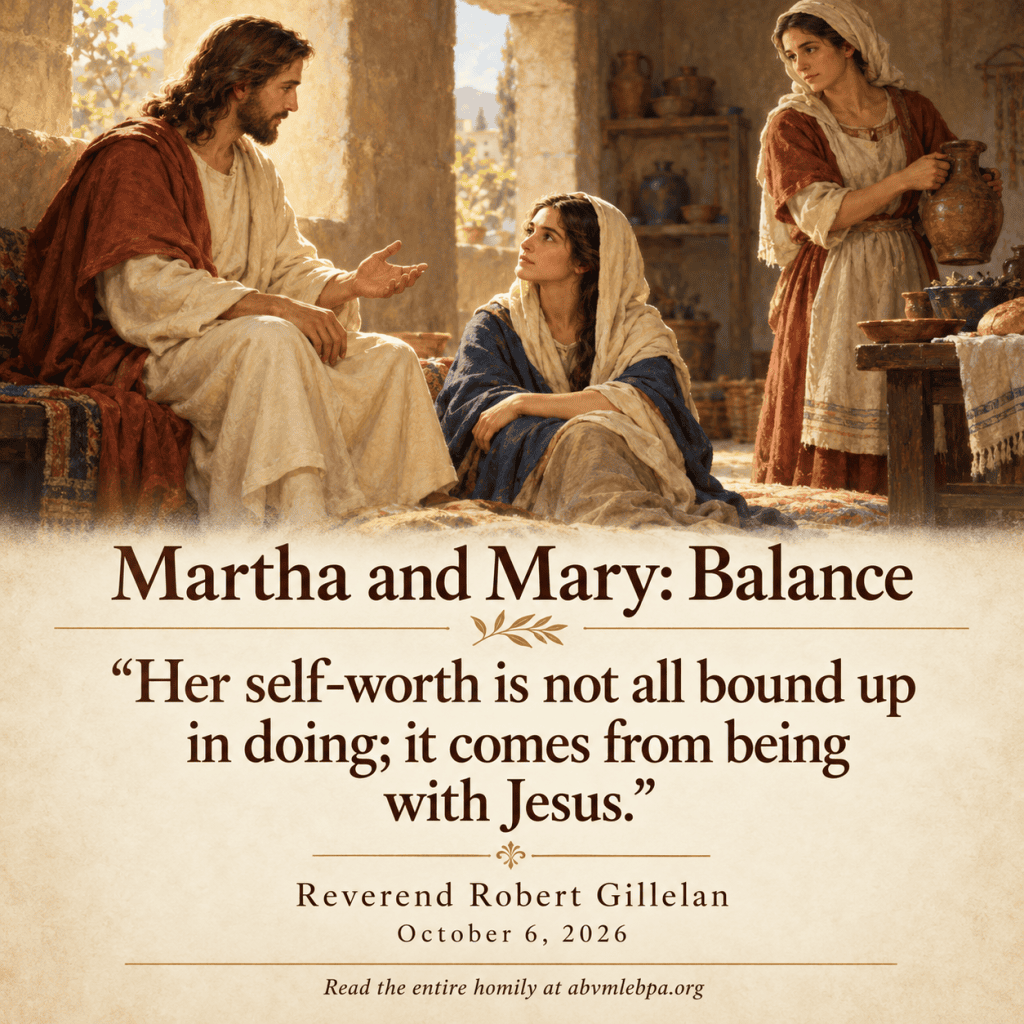
Martha and Mary: Balance
Homily • October 6, 2026
Luke 10: 38-42
If we apply the Myers-Briggs personality test to Martha and Mary, generally speaking, Martha comes out on the end of being extroverted and judging—two main qualities of her personality—while Mary comes out more introverted and intuitive. And even though Jesus says that Mary has chosen the better part, they both have work to do.
Martha is a doer, isn’t she? And we probably all know Martha—maybe some of us are Marthas—the doer of the family.
As we hear in the Gospel, she’s the one—she is the Martha Stewart of the family. She is taking care of the details of hospitality while Jesus visits.
She’s also probably the one that organizes all the family gatherings. And if their parents—Mary, Martha, and Lazarus—if their parents are still alive, it’s likely that Martha is doing the most for her aging parents. So much so that, at times, she may wonder, “Why don’t my brother and sister give me more help?” As we hear today, that’s what she says to Jesus: “I need Mary. Tell her to get up and help me.” So Martha is the doer in the family.
And so, what is her spiritual task? Her spiritual task is to remember that her self-worth is not all bound up in doing; it comes from being with Jesus.
So she needs to remember to move from doing to simply being with Jesus in prayer, who will be the one to animate and inspire her in the future. And remember, this is exactly what God told Saint Ignatius of Loyola in that vision: Ignatius had already founded the Jesuits to do all these great things for God and the Church and the Pope. And on his way to Rome, God gave him a vision whereby God put Jesus and Saint Ignatius together and reminded Ignatius that he needed to be with Jesus. He needed to commune with Jesus, be in union with Jesus, if anything good was going to come from all of his great plans.
So Martha is the doer, and she needs to remember to simply be in prayer with Jesus.
And then there’s Mary, who is with Jesus, and she’s enjoying His talk and is obviously receiving many wonderful consolations and probably wishes that, “Oh, this might never end.” But she needs to be reminded of the tension in her life that’s going to compel her to become more of a doer, to be a doer of the work that… and move out of the comfort of prayer and move into the world where she needs to incarnate Christ’s love to others.
And it was Saint Vincent de Paul who said, “This can be really hard to do,” because oftentimes in prayer we simply want to stay there.
But he said, “Sometimes we have to move from God to God,” meaning we have to move from God in prayer to serving God out there in the world. And for a lot of people, that’s a really hard thing to do.
It occasions a great rupture in one’s life. But you know who did it seamlessly?
Amazingly, it was Mother Teresa of Calcutta. She spent a lot of time in prayer and adoration of the Blessed Sacrament, and she said, “You know, it was seamless.” And it’s amazing that for her it was seamless, because she’s moving from the consolation and the comfort of prayer to serving some of the most needy people the world has ever known, with disease and poverty. And for her, it was seamless.
And when a reporter once said to her, “You know, Mother, you need to spend more time serving the poor and less time in prayer,” she quickly corrected him and let him know that her prayer was the source of her service to the poor.
So we all have a journey, no matter where we fall in our personality type. And the idea is not to change our personality per se, like Martha needing to become Mary and Mary becoming Martha. But they both had to move to where the Lord was drawing them.
Martha towards a little bit more contemplative stance in life to animate her doing, and Mary to move from contemplation into Christ-centered action, which Saint Ignatius of Loyola coined as saying, “We need to be contemplatives in action.”
So let’s pray for that, that we will have the honesty and the wisdom to look deeply into ourselves as the Lord and the Holy Spirit give us that light to discern who we are, where we are, and how we are. And pray for the grace to be those contemplatives in action in the world. The world so desperately needs to see the light and the love of Christ.
God’s Generous Grace
Reverend Robert Gillelan
September 19, 2026
Sorry about my voice. You know, usually after spending five days with the Trappist monks on a silent retreat at Berryville, Virginia, I would come back and my voice would be fresh and livelier, but it always seems to have a hard time waking up, so I’ll do the best I can.
One of the great things about these parables is that a parable always tells us something about the nature of God and the nature of God’s kingdom. And so, with this parable tonight, we know it’s not about business or hiring or wages; it’s about God’s sovereignty and God’s generosity.
And this is something that Jesus apparently really wants us to understand, because we judge so many things as human beings in terms of our model and our standard of what is fair. That’s not how God rations grace at all.
God gives us grace according to our need, and sometimes there is quite a disparity, or it appears that there’s quite a disparity, between what one person gets and what another person gets. But it was St. Thomas Aquinas who reminds us that people perceive different measures of grace based on how well they cooperate with the grace that’s given.
St. Teresa of Ávila was right on board with that, saying that we receive grace and garner holiness precisely according to our readiness to receive that grace and cooperate with it. And one of the disparities that we see in the lives of the saints is that some of these saints got holy really quick.
They became saints at a very young age. We think of Maria Goretti, who had the grace to endure martyrdom; Carlo Acutis, who handled his terminal illness in a sacred way; the Ugandan Martyrs, who were martyred—who were tortured—but even some of those were like ten and eleven and twelve years old.
Saint Thérèse of Lisieux contracted tuberculosis at the age of twenty-four. It would seem that God really loaded them up on the front end of their lives to accomplish His purpose, which was their sanctity, their holiness, and ultimately salvation.
Which brings us to the point of understanding that God gives each and every one of us enough grace every day to attain salvation. And that’s really, really important to understand, because, as we heard in the Gospel tonight, one of the problems in our humanity is that we can start to compare ourselves to other people.
Imagining how much more grace they’re getting than we are, or how much they are progressing in spiritual life and I’m not. And one of the things that the saints consistently tell us is: don’t compare yourself to another person.
If you’re going to compare yourself to someone, as St. Thomas Aquinas says, compare yourself to Jesus, not someone else. Because remember, each of us is on a very unique path to God, and God takes that into consideration, just as you who are parents do with your children.
If one child needs a little bit more help in this area, you give that child more help. It doesn’t mean you love the other children less.
You know what to give this child, but this child does need more. And that’s how God is with us when it comes to God’s distribution of grace in our lives.
God knows what we need, and He gives it to us. We can let go of the myth that health and wealth mean that, well, God favors that person, or that the difficulties and the hardships of my life mean that I’ve fallen out of God’s favor.
Not true at all. Most of the saints experienced serious hardships in their lives, and they used those hardships as opportunities to grow in holiness through the grace that God gave them through that hard time in their life.
Or when we think that our spiritual life is stagnating, it’s stymied, and we ask, “Why is God being so stingy with grace?” One of the things we want to remember is there’s a difference between what we’re feeling and grace.
Sometimes grace feels good, but sometimes God withdraws the feeling without withdrawing the grace. If you’re getting the grace and you’re getting the feeling, then you should feel good about it.
That’s called a consolation. And so this is all about this serious myth of God, who is this incredibly generous giver.
God will not be outdone in generosity. He gives every drop of grace that we need every single day, not only to attain salvation but to grow in personal holiness.
The thing that defeats envy—and envy is the sorrow that we feel for another person’s gain, for their good fortune—and Jesus brought that up in the parable: “Are you envious because I’m generous?”
If you want to check your envy, put yourself in that Gospel. So imagine that you are one of the workers who worked twelve hours, and your best friend comes up to you and says, “Look what happened to me. I got paid a full day’s wage by just showing up at the last minute.” Are you happy for your best friend, or are you mad as a wet hornet? Okay, now you passed that test if you’re really happy for your friend.
Now imagine it’s somebody you don’t know, a total stranger, showing up and saying, “Hey, guess what? I got paid the same as you. You worked twelve hours, I just showed up at the last minute, and I got paid the same.” There’s envy. That’s envy, and that’s a capital sin.
And so the Lord wants us to check that. We’ve got to check ourselves so we don’t wreck ourselves on the rocks of envy.
You know, humility is a powerful virtue that helps us to defeat envy. Humility is really the archenemy of envy.
And one of the things that the Litany of Humility tells us, one of the petitions in there, is, “Lord, may others become holier than I, provided that I may become as holy as You need me to become.” So allowing others to receive all the graces that they need, even if it’s more than what we think we should get, to be satisfied with what the Lord gives us. To be grateful for that.
And there’s a great song—if you remember nothing else from this homily—by Matt Maher. He’s a wonderful Christian leader of a band. One of his songs is called “Your Grace Is Enough.” He’s quoting Saint Paul, actually.
And that’s the whole point: “Lord, Your grace is enough, not only for me to make it through this day, not only for me to survive whatever life throws at me, but it’s enough for me to go just a little bit more into holiness and to ultimately attain salvation.”
So let us thank the Lord for these beautiful parables that reveal something of the nature of God and something of His kingdom. And as we thank the Lord with grateful hearts for the grace that He gives us, may we remember the wisdom in our first reading, remembering that God’s thoughts are above our thoughts, and God’s ways are above our ways.

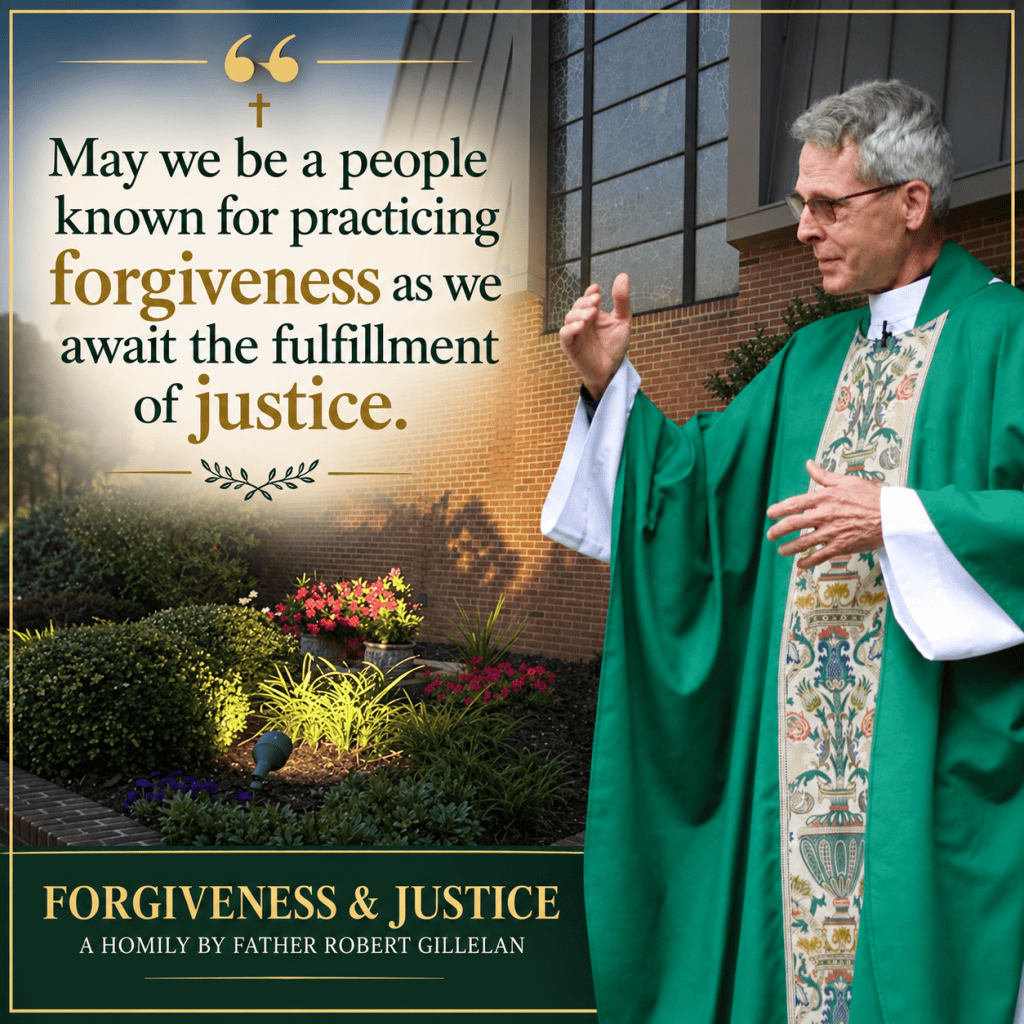
FORGIVENESS & JUSTICE
Reverend Robert Gillelan
September 12, 2026
A Response to the Vandalism of the Statue of the Blessed Mother
You probably know by now, on September 8, this past Tuesday, which was the birthday of our Blessed Mother, late at night our historic statue, painted gold, was vandalized. It was knocked over, it was cracked, some of the parts broke off, and in Church terminology we call that a desecration.
Desecration is when someone with malicious intent tries to damage or destroy a sacred object or something religious that we hold dear. Let me just say, to bring you kind of up to date without throwing a wrench into the wheels of justice, that Bishop Senior knows about this.
The insurance carrier has been contacted. We have some people, professionals, coming in on Tuesday to take a look at the statue and see if it can, in fact, be repaired or at least be replaced.
As some of you know, it was the statue between the spires, in the middle of them. That’s where this statue was in the old church that dates back to the 1870s.
And finally, just so you know, the police are on it, and the detectives also, and are going to do a very good job, so we’ll leave it at that. So if everything is pretty much well in hand, what is there left for us to do?
Well, some people I’ve heard, you know, have told me, “Father, I’m very upset about this. I’m devastated.” Others have said that they’re very angry.
Others have said they feel violated. All normal, very expected feelings in light of that kind of evil. And we’re dealing with two kinds of evil here, really. We’re dealing with being offended by this desecration, which offends God and our Blessed Mother and anyone who holds our Blessed Mother near and dear to their hearts.
And we’re dealing with a crime, a felony. So we’re kind of offended in two ways.
How are we going to deal with that? Funny that we should have this Gospel today, which is about forgiveness.
Because I think it is divinely inspired, because it gives us a way. It gives us a really important spiritual way to deal with these kinds of situations in life.
And so Jesus says, “Forgive.” And interestingly enough, Jesus compares forgiveness to writing off a debt. So how do we apply that to our present situation?
Well, first of all, we can write off a debt that we often feel we owe to ourselves: to get even, to retaliate, to seek revenge against the perpetrator of this offensive crime. But then we realize that Jesus said, “We’re not going to do that.”
We’re not going to do an eye for an eye. What we’re going to do is, “Love your enemies and pray for those who persecute you.” So that’s what we’re going to do.
We’re going to pray for the perpetrator that he will have a kind of conversion and, in the words of Isaiah the prophet, “Stop doing evil and learn to do good.”
Okay, what’s another debt we might write off? How about the debt of an apology? We are owed an apology. Well, we’re also going to write off that debt.
We’re going to write it off because we can’t force anyone to feel sorry.
What’s another debt we’re going to write off? Restitution. Oh my goodness, how can we write that off? We need that to pay for the statue, to have it repaired or replaced.
Restitution, in a spiritual sense, is actually what we call satisfaction. It’s like the penance we do after confession to try to show God that we’re really sorry and we want to make this situation right again. We can’t force anyone to do that. We can’t.
Another debt that we can write off is the demand that we often place on forgiveness. We feel we owe that to ourselves.
We feel it’s just: “I’m not going to forgive this perpetrator until he apologizes, until he pays full restitution, and until he changes his evil ways and has a conversion. Then I’ll forgive him.” Well, you see how we’re adding on to forgiveness and Jesus is subtracting from it?
When we hold on to these kinds of conditions when it comes to forgiveness, we often end up frustrated and angry and bitter and feeling more victimized, because we’re holding on to things we can’t control.
We cannot control an apology or restitution or how someone is going to respond to this situation. Jesus is saying, in effect, “You’ve got to learn to let some things go.” We need to learn to write off the things that we cannot control.
That actually constitutes forgiveness, and it’s good for us. We often think we’re doing forgiveness for the other person, but so often, especially when a person shows absolutely no repentance, forgiveness is unilateral.
It’s something we do for ourselves. Because if we hold on to all these conditions of forgiveness that are never met, we end up unforgiving. We end up angry. That often produces a stress response in us, which releases the cortisol, and we’re not supposed to live in that kind of stressed-out state all the time. It’s not good for our hearts. It’s not good for our minds.
Science has figured that out. We need to get on board. It’s not good to live in a state of unforgiveness.
Okay, so if we write off all of these debts, then aren’t we—aren’t we giving away the farm?
I mean, where is the justice for us? Well, justice for us comes with the other side of the forgiveness coin, which is justice.
And St. Thomas Aquinas tells us that justice is to give to the person what they are owed. And so, with the criminal justice system on board and working for us, what are we owed? We are owed restitution, satisfaction, to make it whole.
What is the perpetrator owed? Well, probably according to the Pennsylvania Crimes Code, he’s owed incarceration, probably fines, and restitution to us.
So in this way, we see that forgiveness and justice are not mutually exclusive, which most people think they are. The fact that we are forgiving of this individual, as we are, doesn’t mean that we give up all justice.
Justice is also a virtue. It’s actually one of the cardinal virtues.
Our entire, you know, Western civilization is strongly based on a system of justice. So we need to make use of it and respect it as we can.
So, two sides of the same coin: forgiveness, which actually helps us with our healing of the situation, and justice, which holds the perpetrator accountable. And in this way, we hope and pray that the situation, you know, finds a peaceful and equitable and just resolution.
So if you’re angry or hurt or feel violated by what has happened, that’s natural. But Jesus says, “Go ahead and try to forgive this,” letting go of the things that we cannot control and trusting that the wheels of justice will, in the end, give us our due.
Those very memorable words in our first reading from Sirach. Sirach tells us that, “Wrath and anger are hateful things, and the sinner hugs them tight.” May we not hug and hang on to anger, wrath, frustration, bitterness, and victimhood in light of this situation.
But may we be a people known for practicing forgiveness as we await the fulfillment of justice.
Fraternal Correction
Reverend Robert Gillelan
September 5, 2026
In tonight’s Gospel, Jesus is talking about fraternal correction – fraternal correction directed toward repentance. And boy, is that a touching subject today.
We also heard in our first reading that even in the Old Testament, in the Jewish faith, a fraternal correction of someone who was sinning was a commandment given by God. What did God say to Ezekiel? If an evil man dies, he will die because of his guilt, but if you don’t correct him, I’m going to hold you also responsible.
So these readings tonight tell us that there is a responsibility on the part of us as Christians to lovingly – let’s underscore that – lovingly, correct and help one another when we have gone astray. And that’s the goal here. You know, this kind of correction today might get the response to someone who’d say, “Don’t push your morals on me.” Or, “Jesus said don’t judge.” Well, Jesus just said that we are supposed to use the faculty of judgment to know when someone sins against us or has gone astray in the faith, and it’s our responsibility to help, to bring them back.
This is not about weaponizing religion, as you would hear today. This is about love, because love is to will the good of the other, as St. Thomas Aquinas has told us numerous times. And willing the good of the other is to bring the sinner back onto the path of righteousness. And so we know from our Church history that the Church has been exercising this discipline of fraternal correction in various ways and forms throughout the millennia.
Some of the things that the Church has had to confront have been those three really big sins of heresy, apostasy, and schism. And all three of those big-time sins are still with us today and require our vigilance and, at times, the Church’s correction.
And notice that Jesus doesn’t say, “Do your best to – do what you can to correct someone.” Jesus actually gives us a plan. He gives us an outline of how to do it.
The first thing He says, if someone sins against you, or in the broader sense of the Church, you know that someone is seriously – has seriously fallen into sin, what do we do? Do we go online and announce it to everyone?
No, first go to the person directly and personally and bring the matter to their attention.
Privately. Not publicly. Not online.
In person. Directly. In charity.
If bringing this matter to their attention doesn’t seem to help them, doesn’t seem to do any good to change their mind and their heart, then we take some other people along with us – with us – like-minded believers, which today we might call an intervention.
We do an intervention to help these people again to see that perhaps they are in the wrong here, and perhaps they do need a bit of correction. And if they don’t listen after the intervention, then we can take it to the Church.
We have seen the Church’s response to these serious sins down through the past 2,000 years: heresy, officially the obstinate denial of a truth to be believed by Catholic faith. In the early Church, some of the heresies were about the nature of Jesus Christ. Some would be heretical because they said He isn’t fully human. Others over here would say, “Well, He’s not fully divine.” And so the Church had to deal with that.
Those kind of heresies led to proclamations and creeds and dogmas. Bishop Barron says those kind of heresies are still with us today, but are with us more regarding the nature of our humanity.
Often these heresies are the secular ideologies that deny the truth about our relationship with God and with one another, and the true nature of our humanity. He tells us we need to be on guard so that they do not infect our core beliefs as Catholics.
Heresy, apostasy. Apostasy is the total repudiation of the Christian faith.
The emperor would say, “Renounce your faith or die.” And so they would renounce their faith as Christians. If you want a really good movie on that, probably not best for children, but great for adults, the movie Silence, about missionaries in Japan.
In the early Church, that was a really big deal because when Christians were under persecution, they would apostatize. Some would repudiate their faith.
Apostasy. And then schism: the refusal of submission to the pope. Here we have an example of what Jesus said, that if you’ve tried to speak with people one-on-one, and if you’ve done an intervention and they still do not have a change of mind and heart, they may need to be excommunicated from the faith community, not primarily as a punishment, but primarily as a medicinal response, driving them out from the community, separating them from the community of faith, like a great big time out, to give them the time to think about what they’ve done and hopefully inspire a bit of conversion. So excommunication directed towards a change of mind and heart.
We recently had an example of excommunication, did we not? When Pope Leo excommunicated, recently, the bishop from the Society of St. Pius X, who attempted to ordain four or five new bishops against the direction of our Holy Father. And he excommunicated them all because they refused to submit to the pope.
You know, today I think people look at that sort of thing and can have a very wrong judgment about the Catholic Church, saying that we’re weaponizing religion. Well, we’re not weaponizing anything.
We’re doing exactly what Jesus said to do in the Bible, in the Gospels. And sometimes excommunication is needed not only to give the sinner the time to convert, but also to protect the integrity and the deposit of faith of the rest of the faithful.
So we’re following Jesus’s instructions when we try to guide people back on track one-on-one, when we do interventions, or when we need the help of the Church to solve some of life’s more difficult problems. And so in the end, we have these disciplines that, you know, some of them are even outlined in the 1983 Code of Canon Law. And when we think of Canon Law, we don’t think of love, but we should think of love and salvation.
The Code of Canon Law directs us how to give expression to fraternal correction in our minds. And its motto is Salus Animarum Suprema Lex. The Latin scholars among us know that that means the salvation of souls is the supreme law.
So as Catholics, we celebrate the law as an instrument of salvation. So let us pray that the Lord may give us the wisdom to know when to exercise fraternal correction, and may He give us the courage and the charity to do it following His teaching.

Suffering & the Messiah
Reverend Robert Gillelan August 30, 2026
Matthew 16: 21-27
We love St. Peter because of his humanity, but in today’s Gospel we hear how Peter’s humanity gets him in hot water with Jesus.
To understand what’s going on, it’s best that we go back to last week to see how this all transpired before St. Peter, who last week Jesus was calling the rock, and this week He’s calling him Satan.
How do you go from hero to zero? Well, if you remember last week, Peter made this miracle profession of faith, that Jesus was the Christ, the anointed one, the Son of the living God.
Upon hearing that, Jesus conferred upon Peter the keys to the kingdom and made him the rock-solid foundation of His church. And then, to show how quickly things can just pivot on a dime, immediately following that, Jesus decides He’s going to tell His disciples about His passion, what awaits Him in Jerusalem.
In your Bible, this is the first prediction of the passion. So Jesus tells Peter and the disciples that when He goes to Jerusalem, He’s going to suffer, die, and rise again on the third day. When Peter hears this, you know, like in that great movie, A Few Good Men, Peter can’t handle the truth. That’s what’s going to happen.
That is Jesus’ truth. But Peter has another truth about the Messiah. Because in Peter’s mind, the Messiah is not a suffering servant Messiah. The Messiah has to be a conquering hero Messiah.
So Peter takes Jesus aside. Remember, Jesus is the Son of God. He is God incarnate. Peter takes Jesus aside and rebukes Him. And tells Him, you know, heaven forbid that anything like that should ever happen to You. You need to disabuse Yourself of that idea.
That’s not the way things happen. Well, the word for rebuke in Greek means to sternly warn. So wrap your mind around that. Here’s Peter, a human being, sternly warning God in the person of Jesus Christ that He’s wrong.
That’s a pretty big deal. And so, Jesus then rebukes Peter. He says, “Get behind me, Satan. You are not thinking like God. You are thinking like a human being.” Maybe that’s instructive to us for what Jesus sees in this encounter.
Because think of somebody else. Think of two other people who thought they knew better than God. Adam and Eve in the garden. Mere human beings thought they knew better than God. So they ate from the tree. They disobeyed God.
Who tempted them to think that they knew better than God? Satan in the form of a serpent. And Satan is all about lies and pride. I think here what Jesus is seeing is kind of this archetypal spiritual pride coming out in St. Peter. It’s kind of insidious because it doesn’t really look like pride. I mean, it is pride because what else can you call it when a mere human being is telling God incarnate that He’s wrong.
So, Jesus needs to correct this situation. He needs to nip it in the bud. To get Peter, the rock foundation of His church, on board to understand His true identity. That Jesus truly is and will be a suffering servant Messiah.
I think it’s probably the rest of the way to Jerusalem that Jesus is trying to impart this to Peter. And Peter is not quick on the uptake. Because remember what happens in the Garden of Gethsemane as Jesus begins to enter into His passion.
What does Peter do? He takes out his sword when the guards come and try to arrest Jesus. He takes out his sword and chops off Malchus’ ear. He’s trying to prevent Jesus from being arrested and entering into His passion.
And so, Peter, you know, is having a hard time understanding our Lord’s true identity. And how a Messiah can actually be a suffering-servant Messiah.
We probably don’t have that kind of problem understanding Jesus as the suffering servant Messiah. But we do at times have a problem with suffering and the Messiah. Our truth about suffering.
Is our truth about suffering always our Lord’s truth about suffering? Do we sometimes pretend that we know better?
Almost four decades, you know, in profession and spiritual direction, I hear things like, “Well, I’m suffering, so God must be punishing me.” Right?
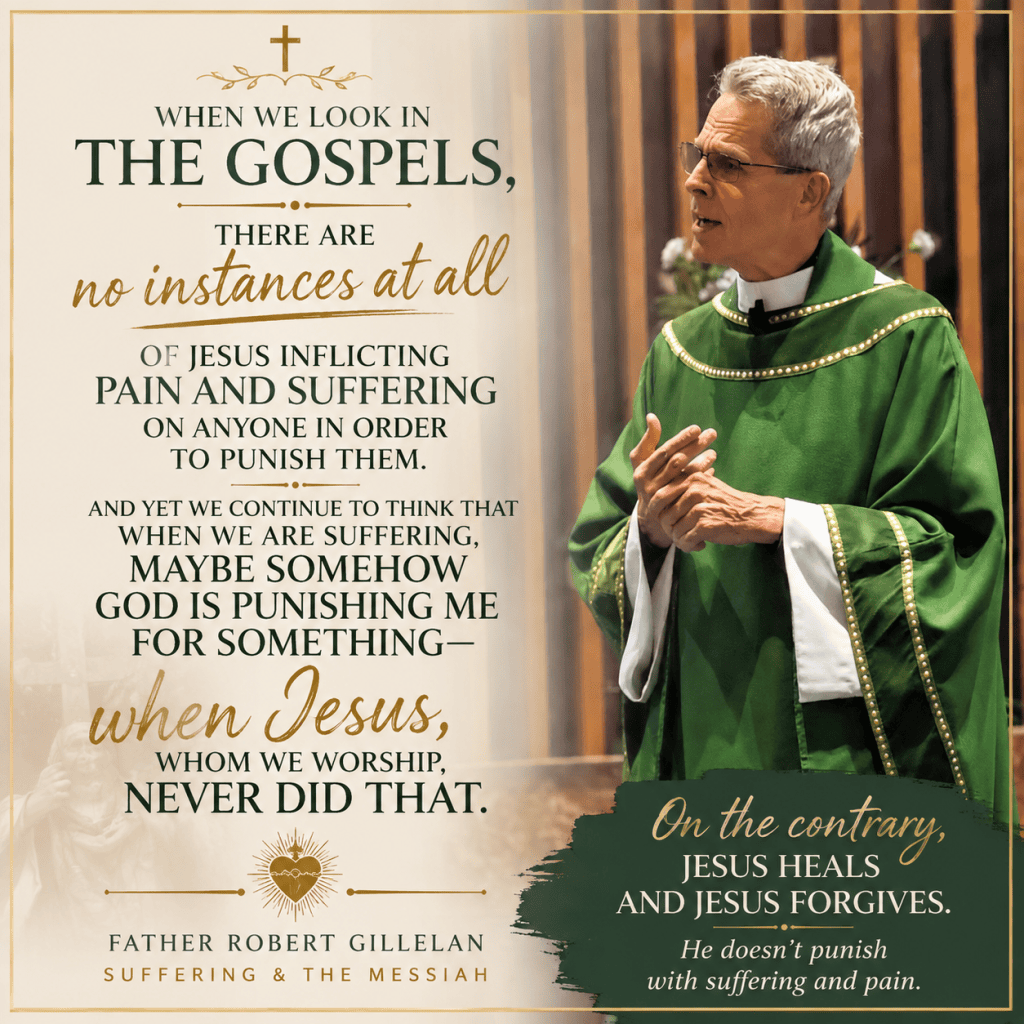
Well, let’s remember that we worship Jesus Christ, who is God. When we look in the Gospels, there are no instances at all of Jesus inflicting pain and suffering on anyone in order to punish them.
And yet we continue to think that when we are suffering, maybe somehow God is punishing me for something when Jesus, whom we worship, never did that. On the contrary, Jesus heals and Jesus forgives. He doesn’t punish with suffering and pain.
Okay. Well, if Jesus isn’t punishing me in my suffering, then maybe He’s abandoned me in my suffering. You know what St. Teresa of Calcutta says about that? She says, when we suffer, we draw close to Christ, and Christ draws close to us. She says, Jesus draws so close to us in our suffering that He kisses us. That’s not abandonment. That’s love and consolation.
Well, if I’m not being punished and if I’m not abandoned, well, I certainly don’t deserve this suffering that I’m going through. No, you don’t. No, you don’t. And neither did Jesus.
But how in the world do we think that somehow we should escape all suffering from this life when Jesus did not. And in fact, we are baptized into His suffering.
When we’re baptized, we’re baptized into the entire life of Jesus. And that life of Jesus and the rhythms of that life are mysteriously reproduced in our life. The good times, the bad times, and the ugly times, the suffering times. And that’s why Jesus in the Gospel says that we have to learn not only to accept suffering in our lives, but to accept it and be able to spiritualize it for a greater good. A good outside of ourselves. That’s what redemptive suffering is all about.
Thats what offering it up is all about. For maybe our spiritual good, for the good of His church and the good of God’s kingdom, and to give greater honor and glory to God.
So for us, no, we don’t deserve to suffer. We do because that’s how it is. But suffering can have deep, deep spiritual meaning as Jesus and the saints tell us and show us by their example. So while we don’t have a problem with the identity of Jesus as the suffering Messiah, let us consider if we do have a problem with suffering and Jesus and how the two go together. Maybe we need a little attitude adjustment on that. And if we do, those words of St. Paul in that second reading in his letter to the Romans are so beautiful that we want to remember. He says, “Do not conform yourself to this age, but be transformed by the renewal of your mind so that you may come to discern what is God’s will, what is good and pleasing and perfect.”
And that includes taking up our cross and following Jesus.