The Catholic Church teaches that not all sin has the same gravity. Sacred Scripture and the tradition of the Church distinguish between mortal sin and venial sin.
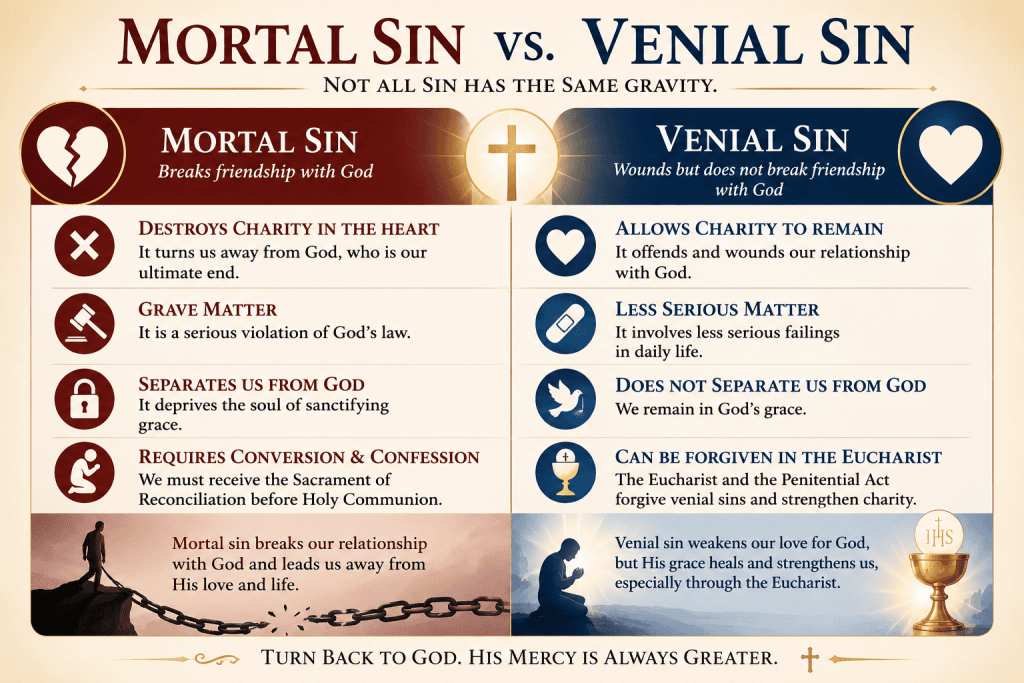
Mortal sin is a grave violation of God’s law. It destroys charity in the heart and turns us away from God by choosing something contrary to Him.
For a sin to be mortal, all three of these conditions must be present:
- Grave matter — the act involves something seriously wrong.
- Full knowledge — the person knows that the act is seriously sinful.
- Deliberate consent — the person freely chooses to commit the act.
A Catholic who is conscious of having committed a mortal sin should not receive Holy Communion without first receiving absolution in the Sacrament of Reconciliation, except in the circumstances provided for by the Church.
This teaching is rooted in Scripture. St. Paul gives a serious warning about receiving the Eucharist unworthily:
“Whoever, therefore, eats the bread or drinks the cup of the Lord in an unworthy manner will be answerable for the body and blood of the Lord.”
— 1 Corinthians 11:27
St. Paul continues by telling Christians to examine themselves before receiving, warning that those who eat and drink without discerning the Body eat and drink judgment upon themselves (see 1 Corinthians 11:28–29).
This is why the Church takes our preparation for Holy Communion so seriously. The Eucharist is truly the Body and Blood of Christ, and receiving Him should never be treated casually.
Venial Sin and the Eucharist
Venial sin wounds our relationship with God but does not destroy charity in the soul or deprive us of sanctifying grace.
A Catholic may receive Holy Communion while having venial sins. In fact, one of the beautiful effects of receiving the Eucharist is the forgiveness of venial sins.
The Catechism teaches: “The Eucharist cannot unite us to Christ without at the same time cleansing us from past sins and preserving us from future sins.”
— Catechism of the Catholic Church, 1393
The Eucharist strengthens the charity within us, and this living charity wipes away venial sins. Through our union with Christ in Holy Communion, we receive grace to resist sin and grow in holiness.
The Catechism further explains that the Eucharist strengthens our charity, which tends to be weakened in daily life, and this living charity wipes away venial sins (CCC 1394).
It also teaches: “By the same charity that it enkindles in us, the Eucharist preserves us from future mortal sins.”
— CCC 1395
This is an important distinction:
Mortal sin ordinarily requires sacramental Confession before receiving Holy Communion. Venial sin does not prevent us from receiving the Eucharist. Rather, the Eucharist is itself a powerful remedy for venial sin.
The Penitential Act at Mass also disposes us to celebrate the sacred mysteries and can obtain forgiveness of venial sins. It does not, however, replace the Sacrament of Reconciliation for mortal sins.
Don’t Be Discouraged by the Struggle
The Christian life is not a life without falls. We may struggle repeatedly with the same weaknesses and become discouraged by our failures. What matters is that we continue turning toward Christ, seeking His mercy and allowing His grace to strengthen us.
As Father Paul Hubert, LC, beautifully reminds us:
“It does not matter if we fall a thousand times, as long as we love the fight and not the fall.”
From the Catechism of the Catholic Church
CCC 1854–1855: The Church distinguishes between mortal and venial sin according to their gravity. Mortal sin destroys charity in the heart; venial sin wounds it but allows charity to remain.
CCC 1857: For a sin to be mortal, three conditions must together be met: grave matter, full knowledge, and deliberate consent.
CCC 1393–1395: The Eucharist strengthens our union with Christ, cleanses us from venial sins, strengthens charity, and helps preserve us from future mortal sin.
The Eucharist does not merely nourish us—it heals and strengthens us in our continuing struggle against sin.