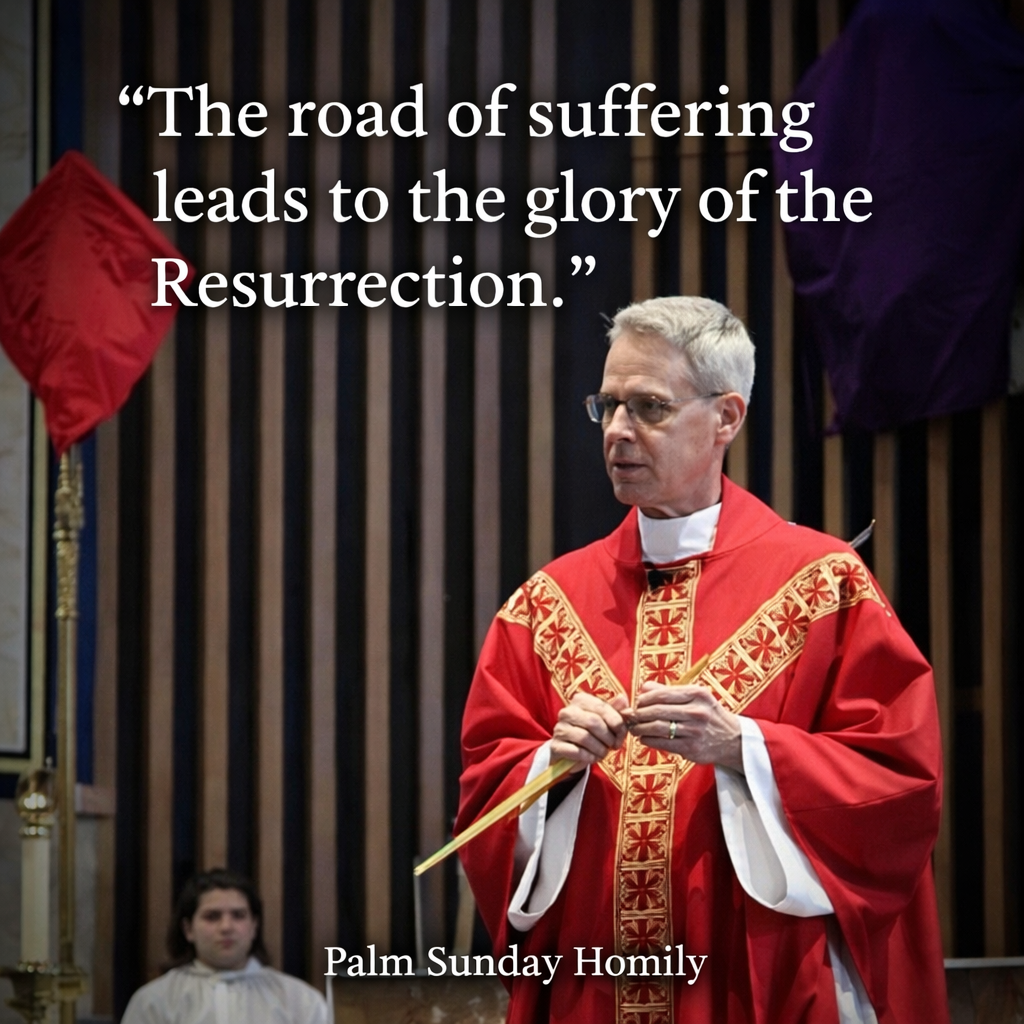
Palm Sunday Homily Reflection
We Love Our Palms
We love our palms, don’t we?
Some have been freshly given to you. Others you may already have at home. Take them and place them in a special spot—perhaps behind your crucifix or near a sacred image—somewhere visible as a reminder of our faith.
We love them because they are such an important reminder to us of victory—the victory of Jesus over sin and death.
They are also a reminder to us, especially during this sacred season, to follow Jesus with a lively faith, hope, and love throughout these days of Holy Week.
As we remember what our salvation cost Jesus, we also remember that by virtue of our Baptism, we share in His very life.
And so we know this truth: the road to glory is the road of suffering.
Or, put another way: the road of suffering leads to the glory of the Resurrection.
And so we take part in this Holy Week—this sacred time—as we gather to celebrate the beautiful liturgies that lead us to Easter.
These palms are an important reminder to us—of history, yes—but also of our lives today. We place them in visible places in our homes because we live in a world that can often seem very dark… a world sometimes marked by sin, error, and uncertainty.
But one thing is certain:
Jesus was in charge—and Jesus is in charge.
As we heard in the Passion, what Jesus did was not taken from Him. As He tells us in John’s Gospel, He willingly laid down His life for our salvation. No one took it from Him. What Jesus did for us was an act of love and self-giving.
So yes, these palms that we place in our homes today are an important reminder of our Catholic faith.
May they remind us of the victory of Jesus over sin and death—of what it cost Him.
And may they also inspire us, especially this week, to follow Him…to ask for His love and His grace… and to walk with Him through Holy Week with a lively faith, hope, and love.
Baptism Changes Everything
John 11: 1-45https://bible.usccb.org/daily-bible-reading
Sunday Homily Reflection – March 22, 2026
At the beginning of Mass today, Father explained why the statues in the church are covered during this season of Lent. This practice helps us enter more deeply into the mystery of Christ’s Passion by removing visual distractions and inviting a more interior focus.
With the exception of the statue of the Assumption, which is too high to safely cover, the veiling of images reminds us that something profound is unfolding. It creates a sense of anticipation as we prepare for the celebration of Easter.
As we continue through the Lenten season, we have been hearing a series of powerful Gospel readings from the Gospel of John—each one rich with meaning and closely tied to the theme of Baptism.
Over the past few weeks, we have reflected on the Samaritan woman at the well, the man born blind, and today, the raising of Lazarus. These are not random selections. The Church presents these Gospels intentionally for the catechumens—those preparing to receive the Sacraments of Baptism, Confirmation, and the Eucharist at the Easter Vigil. But they are also meant for all of us.
Remember Your Baptism
For those of us already baptized, this is a time to reflect on a powerful truth: Baptism was the most important moment of your life.
As Saint Paul the Apostle teaches us, it is in Baptism that we receive the Spirit of God. It is our first true encounter with Christ—and that encounter changes everything.
Encounters That Transform
Each of these Gospel stories shows how an encounter with Jesus transforms a life:
- The Samaritan woman, whose life was marked by disorder and confusion, meets Christ—the Living Water—and finds faith, purpose, and new meaning.
- The man born blind receives not only physical sight, but spiritual vision. Through Jesus, he comes to see the world through the eyes of faith.
- Lazarus is raised from the dead—a powerful reminder that death does not have the final word.
“I Am the Resurrection and the Life”
In the raising of Lazarus, Jesus reveals something extraordinary: He is not only a healer—He is the Resurrection and the Life.
Through Baptism, we are united to Him in His death and resurrection. As we hear in the Church’s funeral prayers:
“In Baptism, N. died with Christ and rose with Him to new life. May he now share with Him eternal glory.”
This is the promise given to each one of us.
Set Free in Christ
Baptism is not just a symbol—it is a transformation. We are no longer bound by sin, no longer trapped in chaos or meaninglessness—we are made new.
As Saint Paul tells us, we become children of the light. And just as Jesus said when Lazarus came out of the tomb, “Untie him and let him go,” so too, in Baptism, we are set free.
A Call to Remember
These Lenten Gospels invite us to remember who we are, what we have received, and the new life we have been given in Christ.
Like Martha, Mary, and Lazarus, we are called to believe: Jesus is the Resurrection and the Life.
Conclusion
Baptism changes everything.
It is the beginning of new life, the promise of resurrection, and the doorway to eternal life in Christ. And as we continue our journey toward Easter, may we rediscover the joy and freedom of being children of God.
Seeing Through the Eyes of Faith
https://bible.usccb.org/bible/readings/031526.cfm
Father Bob’s Homily — Laetare Sunday March 15, 2026
One of the great moral and spiritual problems of our day is that people do not see reality for what it is.
In the Gospel tonight, Jesus says to those who believe they see clearly:
“You say you see, but your sin remains.”
Or to put it another way:
“You think you see, and your blindness remains.”
But not so for the man born blind.
Jesus comes to him as the light of the world. Jesus restores his physical sight, and he is now able to see reality in a whole new way through faith in Jesus Christ.
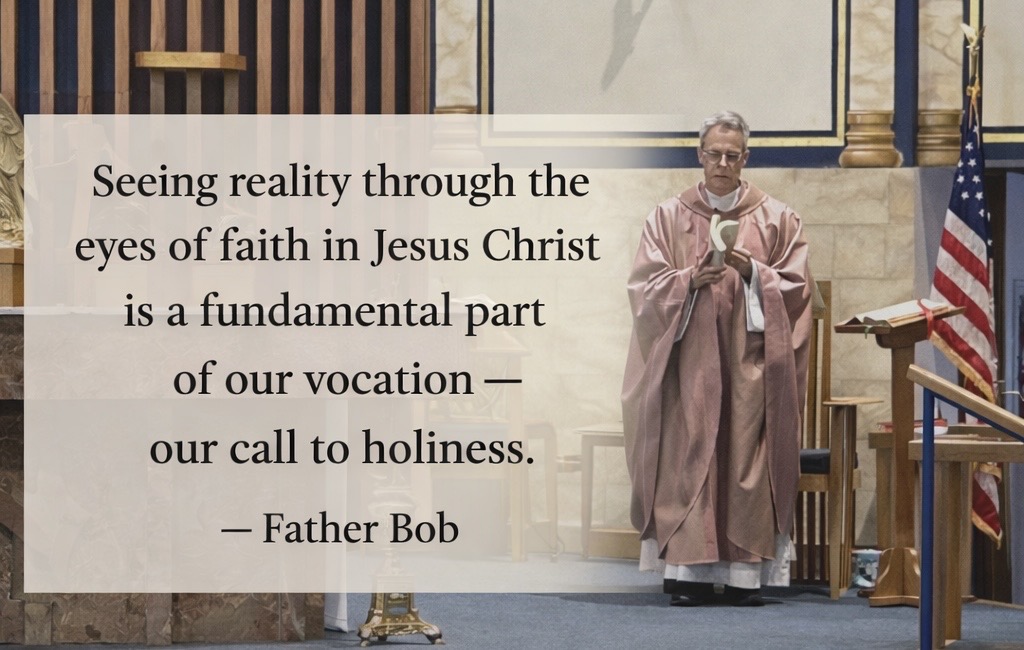
Seeing reality through the eyes of faith in Jesus Christ is a fundamental part of our vocation — our call to holiness. It defines how we are to see the world: through the eyes of faith.
If we think that this is just poetic talk or some kind of abstract thinking, all we need to do is look at salvation history and see how hard God has worked throughout human history to present to us — and call us — to see the world through the eyes of faith.
Go back to the Bronze Age, about 3,500 years ago, to around the year 1500 BC, when God gave Moses the Ten Commandments for the Israelites.
Why did God do that?
To give the Israelites a new reality to live by.
In the Bible, it is called a covenant. We can think of it as a new way of living: a righteous relationship with God and a just relationship with one another.
The Israelites were called to see this new reality and to live in it by following the Ten Commandments.
God told them:
“If you follow these commandments, it will go well for you. If you do not, it will not go well for you.”
And as we know from reading the Bible, it did not always go well for the Israelites, because they often rejected this new reality. When they rejected it, they were unfaithful to God.
So God sent the prophets — men called to remind the people to return to the covenant and to live again in that right relationship with God.
Then Jesus came on the scene.
Jesus — God incarnate, God with us — gave His disciples and followers a new reality.
What was that new reality?
It was the Kingdom of God.
A kingdom with new rules, new commandments, and new ways of living — including Jesus’ law of love:
• Love your enemies
• Forgive others
• Practice radical humility
• Learn to suffer well
• Live the Beatitudes
• Perform the corporal works of mercy
This was the new covenant the disciples were called to live in.
And they did. After Pentecost they became apostles, and they went out into the Roman Empire sharing our Lord’s vision — His kingdom vision for the world.
In sharing that vision , eleven of the twelve apostles were martyred.
After the apostles came the Church Fathers, the martyrs, and the saints of the Church. They understood this new reality — this covenant — and they saw the world through the eyes of faith.
Because they saw the world through the eyes of faith in Jesus Christ, they were able to do wonderful, beautiful, powerful, and unique things.
Just look at the lives of the saints.
From the very beginning we see that God has taken great pains to give us this beautiful reality in which to live.
Just as He gave the Israelites a new reality so they would grow into a holy nation and reflect God’s glory to the world, so too this is part of our vocation.
We are called to live in our Lord’s grace and friendship, to see the world through the eyes of faith, so that Christ becomes our way, our truth, and our life.
When we grow in friendship with Him, we begin to reflect God’s glory to the rest of the world. This is not complicated.But it begins with our worldview — our vision.
Do we understand that this is our call?
Not to live in the darkness of sin that can so easily blind us, but to look to Jesus as our way, our truth, and our life, so that we may share His vision for the world.
Today we celebrate Laetare Sunday, which means to rejoice. So let us praise the Lord. For Jesus is our way, our truth, and our life. Let us ask the Lord to help us not only see this, but also to understand it and to live it in our everyday lives.
Let us pray that the Lord will grant us 20/20 spiritual vision so that we may navigate His kingdom here on earth.
And in the end, by the grace of His Word and Sacrament, may we always be protected from the blindness that comes from sin.
_______________________________________________________________
Looking for Love in All the Right Places. Father Bob. Third Sunday of Lent March 8, 2026
https://bible.usccb.org/bible/readings/030826.cfm
In 1980, Johnny Lee had a hit song called “Looking for Love in All the Wrong Places.” That line describes very well the life of the woman we meet in today’s Gospel.
The Samaritan woman in the Gospel was looking for love, for meaning, for purpose, for direction, for peace, and for salvation in her life — but she wasn’t finding it. Her life, quite frankly, was a mess.
It would began with her marriages. In the longer version of the Gospel, Jesus reveals that she has been married five times, and the man kshe is now living with is not her husband. Marriage had not worked out for her.
Then there were friendships. Friendships were not working out for her either. She goes to the well at noon — the hottest time of the day — and she goes there alone. In that culture, the women of the village would normally go to the well early in the morning when it was cooler, and they would go together. It was a time for community and conversation.
But she goes alone. She apparently has no friends. She is isolated.
And then there is religion.
Even her religion is not working out for her. Jesus points out that the Samaritans do not fully understand how to worship God. Their worship is incomplete, and to the Jews the Samaritan faith was considered both ritually and racially impure.
So in many ways nothing in her life seems to be going well. With all of this, she likely had a very poor self-image.
Until she meets Jesus.
Saint Gregory once described this Gospel by saying that Jesus is the “thirsty fountain.”
At first that sounds strange. How can a fountain — something that pours out water — be thirsty? But when it comes to Jesus, it makes perfect sense. The water flowing from Christ is the overflowing grace of God. And Jesus is “thirsty” in the sense that He deeply desires to give that grace to anyone who wants it.
When Jesus encounters this woman, He recognizes in her a deep longing — a desire for something more meaningful in life. And she finally finds it in Jesus, who is God made flesh.
What a beautiful and powerful message this is — not only for our catechumens, but for all of us.
It invites us to ask ourselves an important question: What are my deepest desires in life?
And even more importantly: Do I recognize that my deepest desire is for Christ?
Do I desire to drink the life-giving water that Jesus offers — the water that comes to us every Sunday in His Word and in the Sacrament of the Holy Eucharist?
Because it is there that we find the love our hearts so desperately seek.
Not only love, but meaning. Purpose. Direction. And that deep and lasting peace that only Jesus can give.
Jesus speaks to us today just as He spoke to the Samaritan woman.
He promises the gift of living water — the grace that satisfies the deepest longings of the human heart.
Some people come searching for that meaning. And if that is what you are searching for, our Lord will not disappoint.
There truly is a recipe for happiness in life.And that recipe is Jesus Christ.
Because Jesus is the life-giving water who longs to share His grace with every person who thirsts for it.
The Samaritan woman may have been looking for love, meaning, and fulfillment in all the wrong places.
But may we learn from her story. And may we always seek love, meaning, and fulfillment in the right place — in Jesus Christ.
Tithing and Helping the Poor
https://bible.usccb.org/daily-bible-reading
Homily by Father Bob, Tuesday March 5
In today’s homily, Father Bob reflects on the Gospel call to care for the poor and explains the biblical wisdom of tithing. His message reminds us that while none of us can solve poverty alone, each of us is called to give what we can with a generous heart.
I think we all understand the meaning of this gospel, that we should not be blind to the needs of the poor.
And we get that, but this is the kind of big gospel that often evokes a bit of scrupulosity or concern on the part of even the most generous Catholics who feel that they’re not doing enough for the poor.
And I know this because they tell me.
Oftentimes they’re elderly, they’re on a fixed income, and on a yearly basis they get hundreds of solicitations from charities and the mail.
“Father, I feel so guilty because I just can’t help everyone.”
Well, when it comes to helping the poor, the Catholic Church, in her wisdom, gives us the biblical guidance of tithing, which is really pretty brilliant when you think about it.
It’s giving 10% right off the top.
God gets the first 10 cents of every dollar.
You get to keep 90 cents.
And this is how that wisdom works out, and it’s been promulgated in our dioceses for a period of time.
An Example of Tithing
So let’s say that you have $30,000 of income.
10% of that is $3,000 that you intend to give to God in the course of the year, to God and the poor.
So you divide that 10% up.
5% to Your Parish
5% of your $30,000 income is $1,500.
That goes to your parish church, fulfilling the precept of supporting your church, and in turn, your church helps to support the poor, for example, with our contribution to LCCM and other monetary gifts.
So by giving to your parish church, you’re invariably helping the poor.
3% to the Diocese
Now you have 5% left over, so you take 3% of that, which is $900, and that goes to the DAC, the Diocesan Annual Campaign, formerly known as the Lenten Appeal Campaign, which goes specifically to some services and ministries which help the poor.
2% to Charity of Your Choice
And now you’ve got 2% left over, which is $600 of your $3,000 you’re giving to God and the poor.
Now you can give that $600 to one charity or six charities.
You can put it in the poor box.
You get to do what you want with that 2% that’s left over.
What This Accomplishes
And now notice that in every way you are doing the gospel mandate to help the poor, you are fulfilling the precept of the church, which is to help the church.
You’re helping your diocese, and you are directly helping the charity or charities of your choice.
If Money Is Tight
And if you say, “Well, money’s a real problem. I’m on a fixed income,” well, you have to determine what you can give to God and to help the poor.
But if you can’t offer financial support, maybe you can volunteer to help the poor.
And if you can’t do that, there’s always prayer.
And on top of prayer, there is fasting.
Fasting, prayer, and almsgiving are Lenten disciplines.
There is always some way to help the poor.
Our Responsibility
And let us remember, Jesus said:
“The poor you will always have with you.”
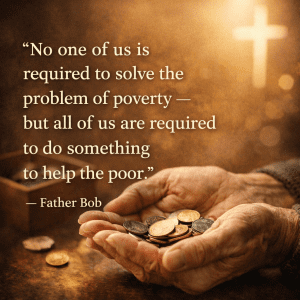
So no one of us is required to solve the problem of poverty, but all of us are required to do something to help the poor.
And so we do what we can.
And as that verse before the gospel reminds us, that God loves a charitable giver, and He would love it for our hearts to be open and generous in helping the poor.
And if you need a way to sort that out in your life, think about our diocesan wisdom, the biblical wisdom of a tithe, and how that helps us, what God is asking us to do, and to do it with a generous heart.
The Transfiguration and the Call to Resilience
Genesis tells us the why of the Transfiguration.
The Transfiguration happened so that Jesus could reveal His glory to the Apostles so they would have the strength to face the scandal of the Cross and understand that it is necessary to pass through many tribulations in order to reach the Kingdom of God.
“Jesus revealed His glory so the disciples could face the scandal of the Cross.”
He Didn’t Bring Them Up to Enjoy the View
When I went to the Holy Land and we went up the Mount of Transfiguration, our tour guide, Father Stephen Doyle—a Franciscan biblical scholar—told us:
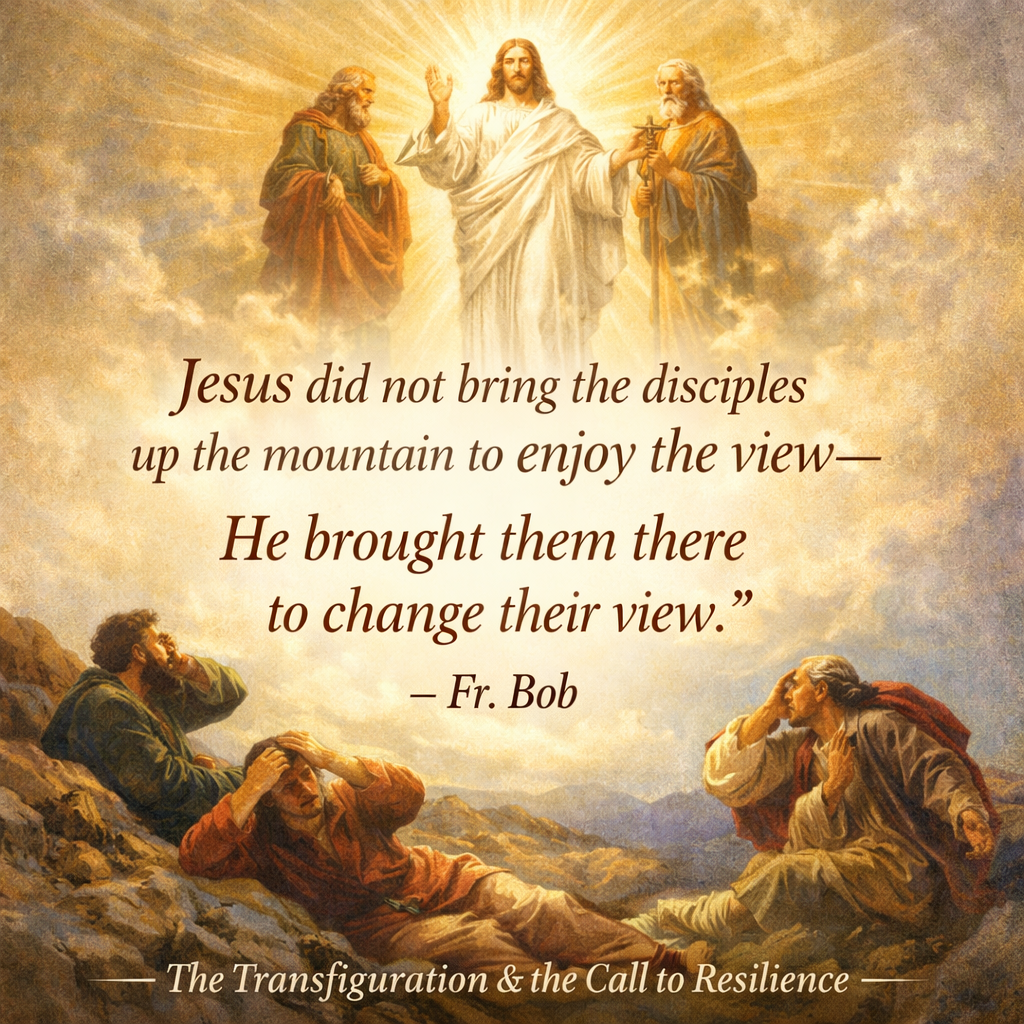
“Fellas, Jesus did not bring Peter, James, and John up here to pray a retreat and enjoy the view.”
Jesus brought them up there to change their view.
He wanted them to understand that the glory of the Resurrection would only come through the suffering and scandal of the Cross. The Transfiguration was intended to strengthen the disciples for that moment.
“Jesus brought them up the mountain to change their view.”
A Spiritual Word We Don’t Use Enough: Resilience
When we talk about being strengthened, I think of a word we do not often use in the spiritual life:
Resilience.
When the disciples came down from that mountain, Jesus needed them to be resilient as they made the difficult journey from the mountain of glory to the little hill of Calvary.
Resilience involves the whole person.
Mental Resilience
Jesus needed His disciples to be mentally resilient—mentally tough for what was coming.
They had to embrace the new reality Jesus was introducing. They had to live in that reality and not escape it by creating fantasies of their own.
They also needed to hold on to the kingdom patterns Jesus was preaching and teaching.
Emotional Resilience
The disciples also needed to be emotionally resilient.
They needed to be in control of their emotions—lest their emotions control them.
How would they respond when people said:
“I hate you because you are a follower of Jesus Christ.”
Jesus predicted that this would happen. Because they hated Him, they would hate His followers.
The disciples needed emotional stability to endure it.
Physical Resilience
They also needed to be physically resilient.
They needed strength and stamina.
Jesus taught that the road to heaven is narrow and difficult, and many are not strong enough to take it.
Following Christ requires endurance.
As the comedian Gary Bowman once joked, “The one thing they never tell you about life is that it’s every single day.”
Life can be exhausting. We need stamina and resilience to continue following Jesus.
Spiritual Resilience
Finally, we need spiritual resilience.
We need the ability to resist temptation and the evil that comes into our lives.
The Austrian neurologist and psychiatrist Viktor Frankl understood how important resilience is to human well-being. Frankl was imprisoned in several Nazi concentration camps.
You may have read his famous book Man’s Search for Meaning.
Frankl observed that one of the most important human qualities is resilience—our ability to survive and even thrive in difficult circumstances.
He noticed that those who woke up each morning and asked themselves:
“What is required of me today in order to survive?”
did much better than those who woke up complaining about how they felt or how they were being mistreated.
The people who had a plan survived.
“The people who had a plan survived.”
Sunday Mass Is the Mountaintop
Every time we gather for Mass on Sunday, we say the Eucharist is the source and summit of the Christian life.
Right now, we are at the summit.
This is the mountaintop of your week.
You are receiving grace through the Word and through the Sacrament.
But soon we will come down off this mountain—like the disciples—and begin our week out in the world.
And we will need resilience.
As Pope Benedict XVI said, the Transfiguration was meant to give the disciples strength to face the scandal of the Cross and understand that it is necessary to pass through many tribulations in order to reach the Kingdom of God.
Temptation & Stewardship
Father Bob’s Homily The First Sunday of Lent February 22, 2026
https://bible.usccb.org/daily-bible-reading
“The temptation story is a descent into the perils that beset mankind, because it lays bare the nature of every temptation: to push God aside because we perceive Him as secondary — if not actually superfluous — compared with all the apparently more urgent matters that fill our lives.” Pope Benedict XVI, Jesus of Nazareth
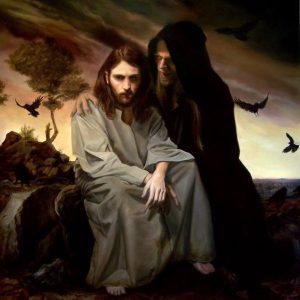
The temptation of Jesus in the desert is a descent into the perils that beset mankind. That Gospel represents for all human beings a descent into those same perils — the perils of temptation. Demonic temptation.
On this First Sunday of Lent, we hear clearly:
Be aware. You may be tempted.
Jesus was tempted.
We may be tempted.
The way these temptations unfold in today’s Gospel exposes how the devil operates — his modus operandi.
First, he goes after the physicality of Jesus. He appeals to His physical hunger. Jesus has been fasting for forty days. He is hungry.
You might think, “What’s the problem? He has the power to turn those stones into delicious bread.” But the problem is this: once you give in a little bit, he takes a lot — until there’s nothing left.
Jesus knows this. He will not compromise His identity as the Son of God for a piece of bread.
And for us, this is about more than controlling our appetite for food. It is about our appetites in the spiritual life — our desires, what St. Thomas Aquinas calls the appetites. The things we want. The way we respond to the world around us. Our feelings.
From early childhood, we are taught to gain some control over this part of our humanity. It is one thing for a two-year-old to have a temper tantrum. It is another thing for an adult to have a temper tantrum.
This is Catholic Spirituality 101.
St. John of the Cross speaks of the “active night of the senses.” It is about understanding our humanity — the parts of us that are disordered — and learning, by grace, to reorder them so that they serve not only us, but God and others.
The devil then goes after the ego. He tempts our Lord with pride.
“If you are the Son of God… prove it.”
Pride can be very subtle. It can manifest itself as selfishness — which is really its root.
Self-recognition: “I’m better than you.”
Self-reliance: “I can do it myself.”
St. Teresa of Calcutta speaks of something she calls “inordinate zeal.” It sounds good — zeal! A desire to do something great for God. But even that can become disordered.
St. Ignatius of Loyola experienced something similar. On his way to Rome, filled with plans to do great things for God and the Church, he came to realize he could not put the world in order by himself. He had to do it in companionship with Jesus Christ — in a life of prayer — always keeping Jesus in the center.
That is a powerful reminder for us. Even our good intentions, even the good things we do for God and the Church, must be done in union with Christ. We cannot do it without Him.
May Jesus be our companion during these forty days — and beyond.
Finally, the devil tempts our Lord with possessions.
“I will give you all the kingdoms of the world.”
But Jesus does not fall for it, because His Kingdom is a spiritual Kingdom.
We must be careful about our relationship with possessions — money, power, influence. God may give us much. Why? So that we may be good stewards.
To use what we have not only for ourselves, but for others.
To give greater honor and glory to God.
It is not about how much we have or how little we have.
It is about how we use it.
Am I using what I have for the Gospel?
Holy Mother Church, in her wisdom, gives us this Gospel to remind us:
Jesus was tempted.
We will be tempted — in our humanity, in our egos, in our desires.
But we have hope.
Because of Jesus — His grace, and His example — we too have the power of hope.
Father Bob’s Homily February 18
Holy Mother Church, in her wisdom, has given us three beautiful disciplines to “return to the Lord with our whole heart” or in the words of Jesus,to “Repent and believe in the gospel” through fasting, prayer, and almsgiving.
While these are spiritual exercises—spiritual things that we actually do—I think they also have very deep symbolic meaning.
For example, fasting is something that is self-referential. It is directed to oneself, right? When we fast—when we give up beer, chocolate, food, entertainment, or something else that we maybe love a little too much—what we are really doing is exercising a form of self-mastery over our habits, our desires, even our feelings.
Fasting symbolically is about ourselves—working on the self, doing that self-work with the help of grace that needs to be done.
And then there is prayer. Prayer is about a relationship with God. Over these next forty days, we hope and pray that by doing our part, that relationship will be deepened.
And then there is almsgiving helping the poor. That’s directed to the other.
Are you seeing a pattern here in the wisdom of Holy Mother Church in giving us these spiritual disciplines and their deeper symbolic meaning?
Fasting: about myself.
Prayer: me and God.
Almsgiving: me and the other, especially the poor.
What does that sound like?
The greatest commandment.
Love God.
Have a relationship with God.
Love others.
Be selfless, sacrificial, and helpful—especially to the poor.
Love yourself.
Take care of yourself.
Work on yourself.
Try to grow in holiness.
So the program for spiritual growth in the Catholic Church during these forty days of Lent is so beautifully planned out and organic, as it fits into the most important commandment Jesus gave us.
Love of God—by trying to foster, from our end, an intimate relationship with the Lord through prayer.
Love your neighbor—by being more selfless and sacrificial and helpful, especially to the poor.
And then to do that work in us—to know what we need to do in this spiritual life—to turn away from sin and turn wholeheartedly to God.
So Holy Mother Church lays it out so beautifully for us.
And tonight, the crosses that are just about ready to be placed on our foreheads are a sign that we are ready to do that work and make this sacrifice.
And it’s not just about us—it’s about our Lord too. As we receive the grace of the Eucharist, we begin these next forty days really very much spiritually energized to do the work that our Lord has placed before us.
So with that, let us pray that the grace of Jesus may be upon all of us, and that the Lord may truly help us to grow in faith hope and love—especially love.
Love of God.
Love of neighbor.
And love of self.
And we’re going to make a beautiful spiritual journey with fasting, prayer, and almsgiving.
Amen.
Father Bob’s Homily – 10:30 AM Mass Sunday, February 15
https://bible.usccb.org/bible/readings/021526.cfm
Have you ever considered your cell phone to be a near occasion of sin? At a previous Mass, someone immediately shouted out, “Yes!” — and I jokingly told her she could turn off the rest of the homily because she already understood the point. A cell phone is not sinful in itself. But how we use it can easily become a near occasion of sin. Our phones and the internet make sin incredibly accessible. They sit in our pockets and handbags, always within reach.In today’s Gospel, Jesus speaks about serious sins — anger, lust, and falsehood. Let us consider how our cell phones can become near occasions of these sins.
Anger
Anger can be a serious and destructive sin when it is not managed properly. The internet makes it very easy to act on anger. When we are upset, we can go online and “vent.” That venting can quickly turn into bullying, gossip, attempts to damage someone’s reputation, or saying cruel and hateful things. From a Catholic moral perspective, these actions are sinful.
Online, it is easy to hide behind a screen. It can feel as though there are no consequences. But there are consequences. People have lost jobs and damaged relationships because of something posted in anger.
Jesus calls us to manage our anger before it grows into something worse. We must be especially vigilant because the internet lowers our inhibitions and increases our impulsivity.
Lust and Pornography
Jesus also speaks about lust. Today, pornography is one of the great moral crises of our time. It is widespread, highly addictive, and extremely destructive. The accessibility of smartphones has made pornography available almost instantly and privately.
Lust is a disordered sexual desire. It objectifies people and undermines the dignity and holiness of human sexuality. It often begins in the imagination — what St. Teresa of Ávila called “la loca de la casa” — “the crazy one in the house.” If we do not guard our imagination, it can lead us into serious sin.
The pornography industry generates enormous revenue — larger than many professional sports leagues combined. It is powerful, pervasive, and designed to hook users.
If someone is struggling with pornography addiction, there is help. Recovery involves real work: therapy, the sacraments — especially Eucharist and Confession — spiritual direction, and accountability. Addiction rewires the brain, but with grace and effort, it can be rewired toward healing. If you need resources, please contact the parish office.
Truth and Falsehood
Jesus also speaks about truthfulness. When He says, “Do not swear,” He is not referring to profanity. He is speaking about swearing oaths by God to prove honesty. Jesus teaches that we should be so truthful that we do not need to swear by God for people to believe us. Our word should be enough.
On the internet, much of what we see is not true. There is deception, manipulation, exaggeration, and outright falsehood.
We even see examples of “deepfakes,” where someone’s image or likeness is digitally altered to make it appear they said or did something they never did. This has happened even to bishops.
Therefore, when we are online, we must be vigilant about what we consume, believe, and share.
Privacy and Our Young People
Our young people are often encouraged to share everything about themselves online. But Catholic morality does not require us to share everything with everyone.
We are not obligated to reveal every detail of our lives to all people at all times. That does not make us deceptive. It means we understand the value of privacy and personal dignity.
Each of us should have a sacred interior space — something reserved for God and not exposed to the entire world.
A Call to Vigilance
Cell phones are not evil. They can be wonderful tools. I am not telling you to throw them away.
But I am asking all of us — myself included — to raise our awareness.
Our phones make certain sins very accessible: anger, lust, and lies.
As we prepare to enter the Lenten season, let us ask ourselves:
How vigilant am I when I am online?
Am I being led into sin — or guided by God?
May we use these tools wisely, with discipline and with grace, so that even in the virtual world, we remain faithful to Christ.

Homily : Living in the Light of Christ. (February 8, 2026 Last Week)
https://bible.usccb.org/bible/readings/020826.cfm
The Gospel writer John tells us in the Christmas Gospel that Jesus came into the world as the Light of the world.
But in today’s Gospel, Jesus says something striking:
“You are the light of the world.”
So which is it?
Is Jesus the Light of the world, or are we the light of the world?
The answer, of course, is both.
Jesus is the divine Light — the heavenly Light who has come into the world. And through Baptism, He shares that Light with us: the light of grace, the light of truth, and the light of love. That is a powerful and precious gift, and Jesus tells us that it is not meant to be kept to ourselves. We are called to share it with the world.
Those of you who are Confirmation candidates will soon receive seven special gifts of the Holy Spirit when you are confirmed by Bishop Senior: wisdom, understanding, knowledge, counsel, fortitude, piety, and fear of the Lord. These gifts are given to help you share the Light of Christ with the world for the rest of your lives.
This calling is more than a metaphor. It’s more than a phrase that simply sounds nice. While our hymns express it beautifully, sharing the Light of Christ is a real and essential part of our lives. It means living our vocation of holiness — our call to become saints.
When we read the lives of the saints — especially the saints you have chosen, or will choose, as your Confirmation names — we see how differently each one shared the Light of Christ. Some were great theological minds. Others had enormous compassion and devoted themselves to caring for the sick. Some, like St. Elizabeth Ann Seton, founded religious communities right down the road in Emmitsburg.
Each saint shared Christ’s Light in a unique and beautiful way — and so are we called to do the same.
With Lent just days away, this is a good moment to practice what St. Ignatius of Loyola encouraged: an examination of conscience. We should reflect honestly on how well we are sharing the Light of Christ in our own lives.
Jesus tells us not to place the light under a basket. It is too powerful and too precious. What we share is the Light of Christ’s truth and His law — and our world desperately needs that light, especially in times marked by darkness, sin, fear, and hatred.
So we are called to be safe beacons of light in the world.
This examination begins with the very start of our day. When we wake up, what is our first thought?
Do we pray, “Lord, help me. Guard me and guide me by Your light” before even getting out of bed?
When we turn on the news or scroll through our screens, do we filter what we see through the Light of our faith?
When we go to work, are our business ethics guided by His Light?
When we go to school, do we test what we are learning by the Light of faith?
What about our relationships?
Our social lives?
Our political views?
Do we discern who and what belongs in our lives through the Light of Christ?
And when we face illness, suffering, or hardship, do we view those moments through His Light — trusting Him even then?
At its core, the question is simple and profound:
Am I living my life immersed in His Light?
That is what faith truly is. It is more than an idea or an analogy — it is a way of life. Living in Christ’s Light does not always make life easier, but it does make life better. It brings clarity — moral clarity and spiritual truth.
The Church has a name for this stage of spiritual growth: the illuminative stage of the spiritual life — when our lives are immersed in, guided by, and illuminated by the Light of Christ.
That is a great gift.
Very soon, our Confirmation candidates will receive the grace to live more fully as bearers of that Light in the world. And for all of us today, as we hear these powerful words and receive the grace of the sacraments, let us pray that we may truly live what Jesus teaches us.
As He says in the Gospel:
May His light shine before all,
so that they may see our good works
and give glory to the Father.
Amen.