“Looking for older homilies? Visit our Printable Homily Page.”
👉🏼https://abvmlebpa.org/6173-2/
Fraternal Correction
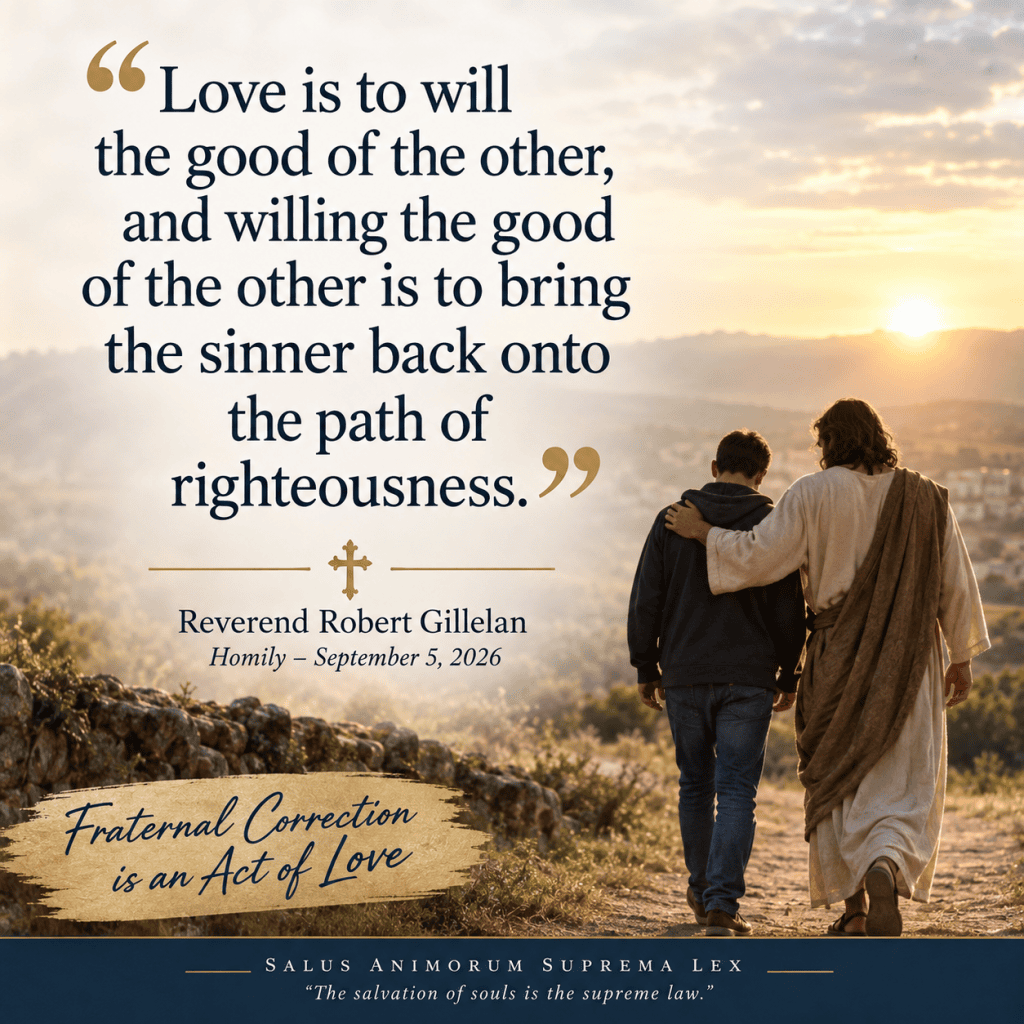
Reverend Robert Gillelan
September 5, 2026
In tonight’s Gospel, Jesus is talking about fraternal correction – fraternal correction directed toward repentance. And boy, is that a touching subject today.
We also heard in our first reading that even in the Old Testament, in the Jewish faith, a fraternal correction of someone who was sinning was a commandment given by God. What did God say to Ezekiel? If an evil man dies, he will die because of his guilt, but if you don’t correct him, I’m going to hold you also responsible.
So these readings tonight tell us that there is a responsibility on the part of us as Christians to lovingly – let’s underscore that – lovingly, correct and help one another when we have gone astray. And that’s the goal here. You know, this kind of correction today might get the response to someone who’d say, “Don’t push your morals on me.” Or, “Jesus said don’t judge.” Well, Jesus just said that we are supposed to use the faculty of judgment to know when someone sins against us or has gone astray in the faith, and it’s our responsibility to help, to bring them back.
This is not about weaponizing religion, as you would hear today. This is about love, because love is to will the good of the other, as St. Thomas Aquinas has told us numerous times. And willing the good of the other is to bring the sinner back onto the path of righteousness. And so we know from our Church history that the Church has been exercising this discipline of fraternal correction in various ways and forms throughout the millennia.
Some of the things that the Church has had to confront have been those three really big sins of heresy, apostasy, and schism. And all three of those big-time sins are still with us today and require our vigilance and, at times, the Church’s correction.
And notice that Jesus doesn’t say, “Do your best to – do what you can to correct someone.” Jesus actually gives us a plan. He gives us an outline of how to do it.
The first thing He says, if someone sins against you, or in the broader sense of the Church, you know that someone is seriously – has seriously fallen into sin, what do we do? Do we go online and announce it to everyone?
No, first go to the person directly and personally and bring the matter to their attention.
Privately. Not publicly. Not online.
In person. Directly. In charity.
If bringing this matter to their attention doesn’t seem to help them, doesn’t seem to do any good to change their mind and their heart, then we take some other people along with us – with us – like-minded believers, which today we might call an intervention.
We do an intervention to help these people again to see that perhaps they are in the wrong here, and perhaps they do need a bit of correction. And if they don’t listen after the intervention, then we can take it to the Church.
We have seen the Church’s response to these serious sins down through the past 2,000 years: heresy, officially the obstinate denial of a truth to be believed by Catholic faith. In the early Church, some of the heresies were about the nature of Jesus Christ. Some would be heretical because they said He isn’t fully human. Others over here would say, “Well, He’s not fully divine.” And so the Church had to deal with that.
Those kind of heresies led to proclamations and creeds and dogmas. Bishop Barron says those kind of heresies are still with us today, but are with us more regarding the nature of our humanity.
Often these heresies are the secular ideologies that deny the truth about our relationship with God and with one another, and the true nature of our humanity. He tells us we need to be on guard so that they do not infect our core beliefs as Catholics.
Heresy, apostasy. Apostasy is the total repudiation of the Christian faith.
The emperor would say, “Renounce your faith or die.” And so they would renounce their faith as Christians. If you want a really good movie on that, probably not best for children, but great for adults, the movie Silence, about missionaries in Japan.
In the early Church, that was a really big deal because when Christians were under persecution, they would apostatize. Some would repudiate their faith.
Apostasy. And then schism: the refusal of submission to the pope. Here we have an example of what Jesus said, that if you’ve tried to speak with people one-on-one, and if you’ve done an intervention and they still do not have a change of mind and heart, they may need to be excommunicated from the faith community, not primarily as a punishment, but primarily as a medicinal response, driving them out from the community, separating them from the community of faith, like a great big time out, to give them the time to think about what they’ve done and hopefully inspire a bit of conversion. So excommunication directed towards a change of mind and heart.
We recently had an example of excommunication, did we not? When Pope Leo excommunicated, recently, the bishop from the Society of St. Pius X, who attempted to ordain four or five new bishops against the direction of our Holy Father. And he excommunicated them all because they refused to submit to the pope.
You know, today I think people look at that sort of thing and can have a very wrong judgment about the Catholic Church, saying that we’re weaponizing religion. Well, we’re not weaponizing anything.
We’re doing exactly what Jesus said to do in the Bible, in the Gospels. And sometimes excommunication is needed not only to give the sinner the time to convert, but also to protect the integrity and the deposit of faith of the rest of the faithful.
So we’re following Jesus’s instructions when we try to guide people back on track one-on-one, when we do interventions, or when we need the help of the Church to solve some of life’s more difficult problems. And so in the end, we have these disciplines that, you know, some of them are even outlined in the 1983 Code of Canon Law. And when we think of Canon Law, we don’t think of love, but we should think of love and salvation.
The Code of Canon Law directs us how to give expression to fraternal correction in our minds. And its motto is Salus Animarum Suprema Lex. The Latin scholars among us know that that means the salvation of souls is the supreme law.
So as Catholics, we celebrate the law as an instrument of salvation. So let us pray that the Lord may give us the wisdom to know when to exercise fraternal correction, and may He give us the courage and the charity to do it following His teaching.
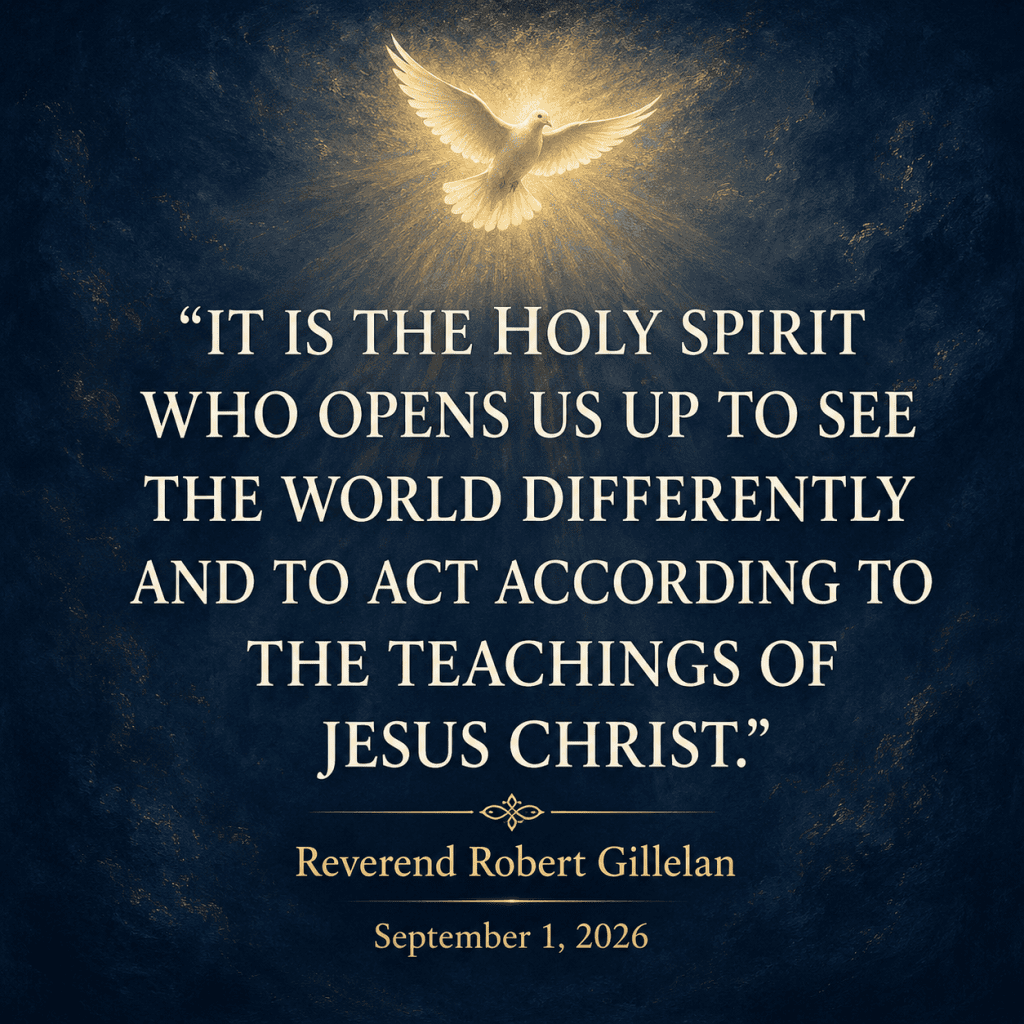
The Gifts of the Holy Spirit
September 1, 2026. Reverend Robert Gillelan
In our first reading from Saint Paul to the Corinthians (1 Corinthians 2:10b-16), we hear a wonderful explanation of why there continues to be such a divide in our world today between those who see the world through a spiritual vision and those who do not. Saint Paul speaks about those who have received the Spirit of God, Whom we understand to be the Holy Spirit, received in Baptism.
We often associate the Holy Spirit and the giving of the gifts of the Holy Spirit with Confirmation. But we also need to remember that, through the Holy Spirit, ever since Baptism we have been able to receive the seven holy gifts of the Holy Spirit, which help us to see the world differently – to see it with a spiritual vision.
Have you ever considered the seven gifts of the Holy Spirit and how they follow a kind of continuum? Consider the gift of knowledge. Knowledge helps us to see things as they are. So let us take abortion, for example. We can know what abortion is. Then there is the gift of understanding: we can understand what abortion does. It stops a heartbeat.
Then there is wisdom, through which we take the knowledge and understanding we have and make a good choice regarding abortion – which is often, “Do not do it. It violates the Fifth Commandment.”
Then there is counsel. Counsel is a form of willing the good of another and sharing our wisdom with that person. Regarding abortion, I am trying to discourage someone from going through with it.
So we have knowledge, understanding, wisdom, and counsel. Then there is piety. Piety is really a loyalty, or living up to one’s duty. We are loyal to Christ. That is why we have this knowledge, understanding, and wisdom, and why we want to share it with another person: because we are loyal to Jesus and His teachings.
Especially when it comes to a topic like abortion in our world today, we need fortitude, the next gift of the Holy Spirit, to speak out against abortion.
Finally, we come to fear of the Lord. “Fear of the Lord is the beginning of wisdom,” says Proverbs, which takes us back to the beginning. It is the Holy Spirit Who opens us up to see the world differently and to act according to the teachings of Jesus Christ.
Saint Paul also says something here that can be a little confusing. He says, “The one who is spiritual, however, can judge everything, but is not subject to judgment by anyone.” That is, those of us who see the world through the gifts of the Holy Spirit are able to use the faculty of reason to judge everything according to the teachings of Christ and His Church.
Of course, we can be subject to legitimate human judgment. If we commit a crime, we will be judged by a jury or a judge. What Saint Paul means here is that we may be judged wrongly by people in this world who do not live by the gifts of the Holy Spirit. In matters of faith, they do not have the capacity to judge us rightly.
For example, because we follow the wisdom of God regarding abortion, they call us far-right extremists. That is a wrong judgment upon Christians. And the list goes on.
You know, we are called far-right extremists if we do not believe that a man can become a woman or that a woman can become a man. We are called far-right extremists.
What Saint Paul told us almost two thousand years ago remains true today. It is the message of Bishop Barron and a message that I strongly proclaim: We must remember who we are. We have been given the gifts of the Holy Spirit at Baptism and the fire and light of Christ every time we receive the Holy Eucharist. It is that fire and light that touches our minds and makes us able to see the world differently than pretty much everyone else.
Today, that makes us different. It can also make us targets, and it can make it difficult to live our faith in this world. Let us pray that, through His Holy Word and through the gift of the Eucharist, we will be generously endowed with the seven gifts of the Holy Spirit, so that we may continue to live in our Lord’s grace and friendship and proclaim His wisdom throughout all of creation.
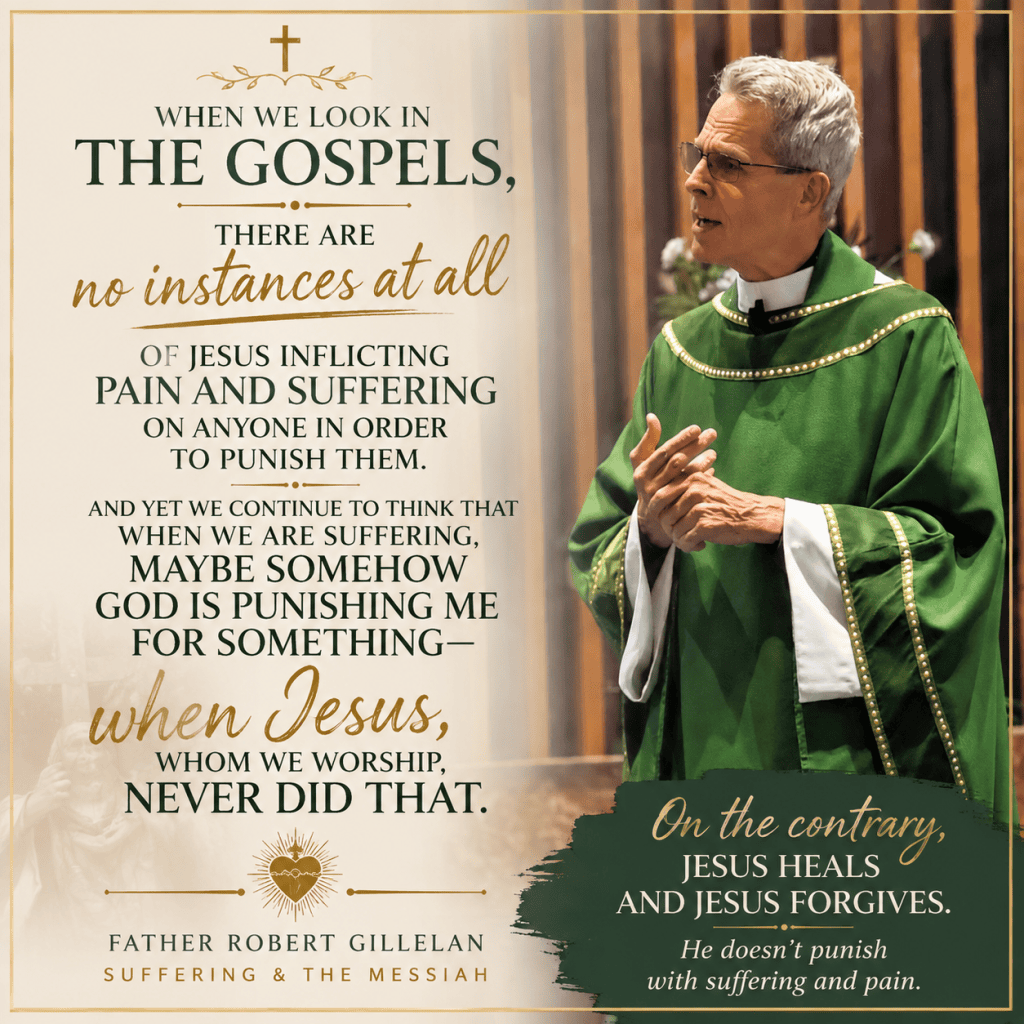
Suffering & the Messiah
Reverend Robert Gillelan August 30, 2026
Matthew 16: 21-27
We love St. Peter because of his humanity, but in today’s Gospel we hear how Peter’s humanity gets him in hot water with Jesus.
To understand what’s going on, it’s best that we go back to last week to see how this all transpired before St. Peter, who last week Jesus was calling the rock, and this week He’s calling him Satan.
How do you go from hero to zero? Well, if you remember last week, Peter made this miracle profession of faith, that Jesus was the Christ, the anointed one, the Son of the living God.
Upon hearing that, Jesus conferred upon Peter the keys to the kingdom and made him the rock-solid foundation of His church. And then, to show how quickly things can just pivot on a dime, immediately following that, Jesus decides He’s going to tell His disciples about His passion, what awaits Him in Jerusalem.
In your Bible, this is the first prediction of the passion. So Jesus tells Peter and the disciples that when He goes to Jerusalem, He’s going to suffer, die, and rise again on the third day. When Peter hears this, you know, like in that great movie, A Few Good Men, Peter can’t handle the truth. That’s what’s going to happen.
That is Jesus’ truth. But Peter has another truth about the Messiah. Because in Peter’s mind, the Messiah is not a suffering servant Messiah. The Messiah has to be a conquering hero Messiah.
So Peter takes Jesus aside. Remember, Jesus is the Son of God. He is God incarnate. Peter takes Jesus aside and rebukes Him. And tells Him, you know, heaven forbid that anything like that should ever happen to You. You need to disabuse Yourself of that idea.
That’s not the way things happen. Well, the word for rebuke in Greek means to sternly warn. So wrap your mind around that. Here’s Peter, a human being, sternly warning God in the person of Jesus Christ that He’s wrong.
That’s a pretty big deal. And so, Jesus then rebukes Peter. He says, “Get behind me, Satan. You are not thinking like God. You are thinking like a human being.” Maybe that’s instructive to us for what Jesus sees in this encounter.
Because think of somebody else. Think of two other people who thought they knew better than God. Adam and Eve in the garden. Mere human beings thought they knew better than God. So they ate from the tree. They disobeyed God.
Who tempted them to think that they knew better than God? Satan in the form of a serpent. And Satan is all about lies and pride. I think here what Jesus is seeing is kind of this archetypal spiritual pride coming out in St. Peter. It’s kind of insidious because it doesn’t really look like pride. I mean, it is pride because what else can you call it when a mere human being is telling God incarnate that He’s wrong.
So, Jesus needs to correct this situation. He needs to nip it in the bud. To get Peter, the rock foundation of His church, on board to understand His true identity. That Jesus truly is and will be a suffering servant Messiah.
I think it’s probably the rest of the way to Jerusalem that Jesus is trying to impart this to Peter. And Peter is not quick on the uptake. Because remember what happens in the Garden of Gethsemane as Jesus begins to enter into His passion.
What does Peter do? He takes out his sword when the guards come and try to arrest Jesus. He takes out his sword and chops off Malchus’ ear. He’s trying to prevent Jesus from being arrested and entering into His passion.
And so, Peter, you know, is having a hard time understanding our Lord’s true identity. And how a Messiah can actually be a suffering-servant Messiah.
We probably don’t have that kind of problem understanding Jesus as the suffering servant Messiah. But we do at times have a problem with suffering and the Messiah. Our truth about suffering.
Is our truth about suffering always our Lord’s truth about suffering? Do we sometimes pretend that we know better?
Almost four decades, you know, in profession and spiritual direction, I hear things like, “Well, I’m suffering, so God must be punishing me.” Right?
Well, let’s remember that we worship Jesus Christ, who is God. When we look in the Gospels, there are no instances at all of Jesus inflicting pain and suffering on anyone in order to punish them.
And yet we continue to think that when we are suffering, maybe somehow God is punishing me for something when Jesus, whom we worship, never did that. On the contrary, Jesus heals and Jesus forgives. He doesn’t punish with suffering and pain.
Okay. Well, if Jesus isn’t punishing me in my suffering, then maybe He’s abandoned me in my suffering. You know what St. Teresa of Calcutta says about that? She says, when we suffer, we draw close to Christ, and Christ draws close to us. She says, Jesus draws so close to us in our suffering that He kisses us. That’s not abandonment. That’s love and consolation.
Well, if I’m not being punished and if I’m not abandoned, well, I certainly don’t deserve this suffering that I’m going through. No, you don’t. No, you don’t. And neither did Jesus.
But how in the world do we think that somehow we should escape all suffering from this life when Jesus did not. And in fact, we are baptized into His suffering.
When we’re baptized, we’re baptized into the entire life of Jesus. And that life of Jesus and the rhythms of that life are mysteriously reproduced in our life. The good times, the bad times, and the ugly times, the suffering times. And that’s why Jesus in the Gospel says that we have to learn not only to accept suffering in our lives, but to accept it and be able to spiritualize it for a greater good. A good outside of ourselves. That’s what redemptive suffering is all about.
Thats what offering it up is all about. For maybe our spiritual good, for the good of His church and the good of God’s kingdom, and to give greater honor and glory to God.
So for us, no, we don’t deserve to suffer. We do because that’s how it is. But suffering can have deep, deep spiritual meaning as Jesus and the saints tell us and show us by their example. So while we don’t have a problem with the identity of Jesus as the suffering Messiah, let us consider if we do have a problem with suffering and Jesus and how the two go together. Maybe we need a little attitude adjustment on that. And if we do, those words of St. Paul in that second reading in his letter to the Romans are so beautiful that we want to remember. He says, “Do not conform yourself to this age, but be transformed by the renewal of your mind so that you may come to discern what is God’s will, what is good and pleasing and perfect.”
And that includes taking up our cross and following Jesus.
Why Catholics Believe What We Believe
Created on August 23, 2026
Reverend Robert Gillelan
What if somebody asked you, “Why do you Catholics do that? Why do you Catholics believe that? No, it’s not in the Bible?”
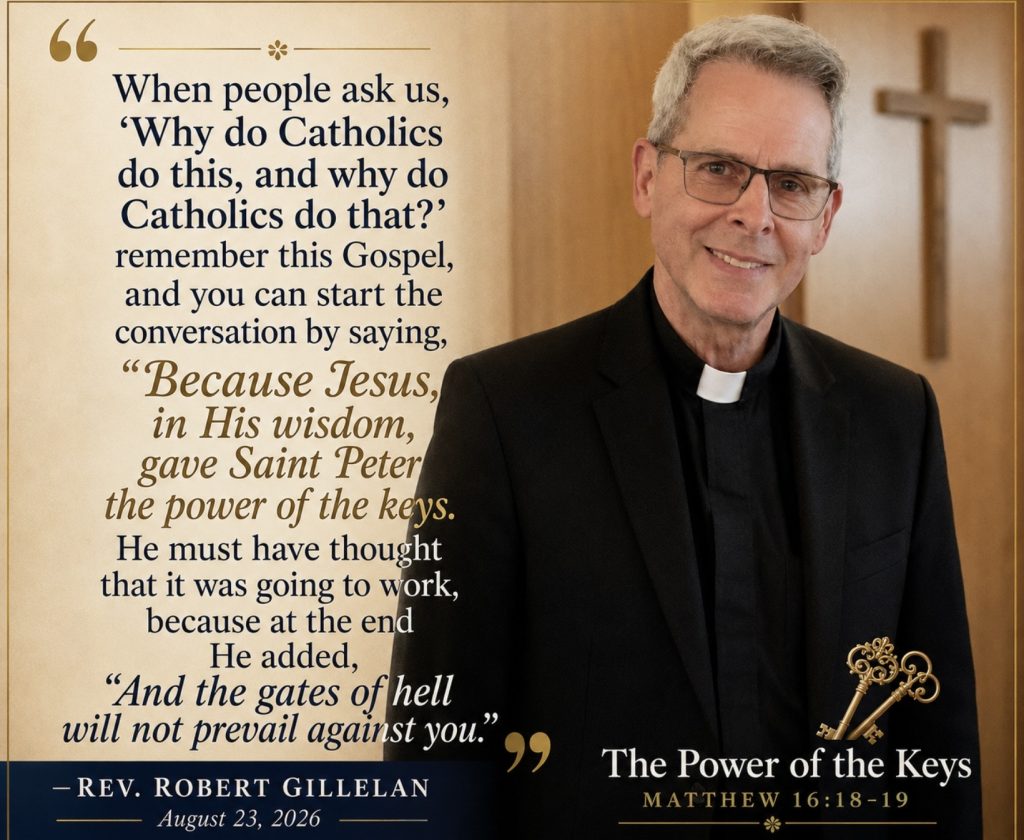
Well, the short answer to that is, we do some things and we believe a lot of things because Jesus gave the power of the keys to St. Peter. That’s the short answer.
The longer answer is, we believe as we do and we do as we do because when Jesus gave Peter the power of the keys, of course, we’re not talking about real keys here. We’re talking about Jesus conferring authority onto St. Peter.
And as we know, authority is the right to use power, to exercise power. And so, Jesus is saying to Peter, “I’m going to make you a leader. I’m going to give you authority, and l need you to exercise that authority in my name, in matters of faith and morals, directed towards the spiritual well-being and salvation.”
In exercising this power, when we look at Church history, we see that the popes throughout the course of history-and the popes are the successors of St. Peter-all of the popes that have sat on the Chair of St. Peter have received this charism of binding and loosing.
We see this being exercised down through the course of history in the areas of teaching and governance of the Church, and spirituality and sanctification. Those are the areas where this shows up.
For example, if someone were to say to you, “Why do you Catholics believe the Assumption of Mary? It’s not in the Bible?”
Correct. It’s not explicitly in the Bible.
But after centuries of reflecting on this mystery and with the help of the Holy Spirit-remember something else that Jesus said: “I’m going to give you the Holy Spirit to lead you into all truth.” With the help of Gospel reflection, with the help of the Holy Spirit, Pope Pius XII, in 1950, proclaimed Mary’s Assumption into heaven, that that should be a doctrine that all Catholics should accept as true.
And we do. And no, it is not explicitly in the Bible, but the Pope has given us that to help us on our spiritual way.
It’s another piece of our faith that helps us in the spiritual life and gives us hope. And so, that’s why we believe, because the Pope said so.
That’s not an answer that’s very satisfying to people today. But that’s an answer that shows that we understand the primacy of the Pope-the primacy which Jesus gave explicitly to St. Peter and his successors.
So, that’s an example of how this charism of the power of the keys might express itself when it comes to Church teaching and doctrine. But it also expresses itself when it comes to sin and sanctification.
So, here’s another question you’ve probably got in your lifetime: Why do Catholics go to confession to a priest?
That’s not in the Bible either.
Well, we go to confession to a priest, actually now, because of the 6th-century Irish concept. Because in the 6th century, they were the ones who introduced individual confessions as we know them today-individual private confessions.
And it was, I believe, Pope Innocent III, who confirmed at the Fourth Lateran Council in the year 1215 that all Catholics should go to confession at least once a year to confess their mortal sins.
So, why do you go to confession?
Well, number one, because Jesus instituted it as a sacrament. John 20: remember what happened on Easter evening when Jesus came among the apostles and He breathed on them the Holy Spirit and said, “Whose sins you forgive are forgiven them, and whose sins you retain are retained.”
We believe as Catholics that’s where Jesus instituted the sacrament of confession, and that He actually wanted to, in a sense, hear your confessions and forgive sins, and that the ministry would endure in the Church.
So, another short answer: why do Catholics go to confession to a priest? Well, because Jesus and Pope Innocent Ill said we should.
And then another place where this charism of binding and loosing the power of the keys to make these important decisions-shows up is in Church governance and order. And, boy, for that we go to the 1983 Code of Canon Law.
And virtually none of that we’re going to find in the Bible, because it’s all the rules and regulations of the Church.
And who put that on the table? Another pope.
Pope Saint John Paul Il in 1983, because when you have a Church with 1.14 billion people, you need some governance.
And so, for example, why do you need a baptismal certificate? If you want to get married in the Church, why do you need a baptismal certificate brought in to the deacon or myself that’s only six months old? Why can’t you bring in a baptismal certificate that’s stuck in the Bible when you were baptized, you know, 20, 25 years ago?
Because the newer baptismal certificate has a lot of information on it that we need, because a lot has happened to you since your baptism regarding the sacraments. And that’s not in the Bible, is it?
All those kinds of rules and regulations are there for the spiritual good of the faithful and for the order and well-ordering of the Church and the administration of the sacraments.
So, when people ask us as Catholics, “Why do we believe something, or why don’t we do something?” you can probably name a pope who signed some kind of decree to put it on the table as part of our apostolic faith and something that they want us to be aware of and use to help us in our spiritual growth.
So, today, let’s consider Leo XIV, who also has received the power as successor of Saint Peter. And let’s pray for him that he will use that charism wisely and courageously to lead his flock.
And while we know that this is a tremendous responsibility, let us also pray for all the bishops in communion with our Holy Father, that they will be faithful to their apostolic offices.
So, when people ask us, “Why do Catholics do this, and why do Catholics do that?” remember this Gospel, and you can start the conversation by saying, “Because Jesus, in His wisdom, gave Saint Peter the power of the keys.” He must have thought that it was going to work, because at the end He added, “And the gates of hell will not prevail against you.”
August 16
Reverend Robert Gillelan
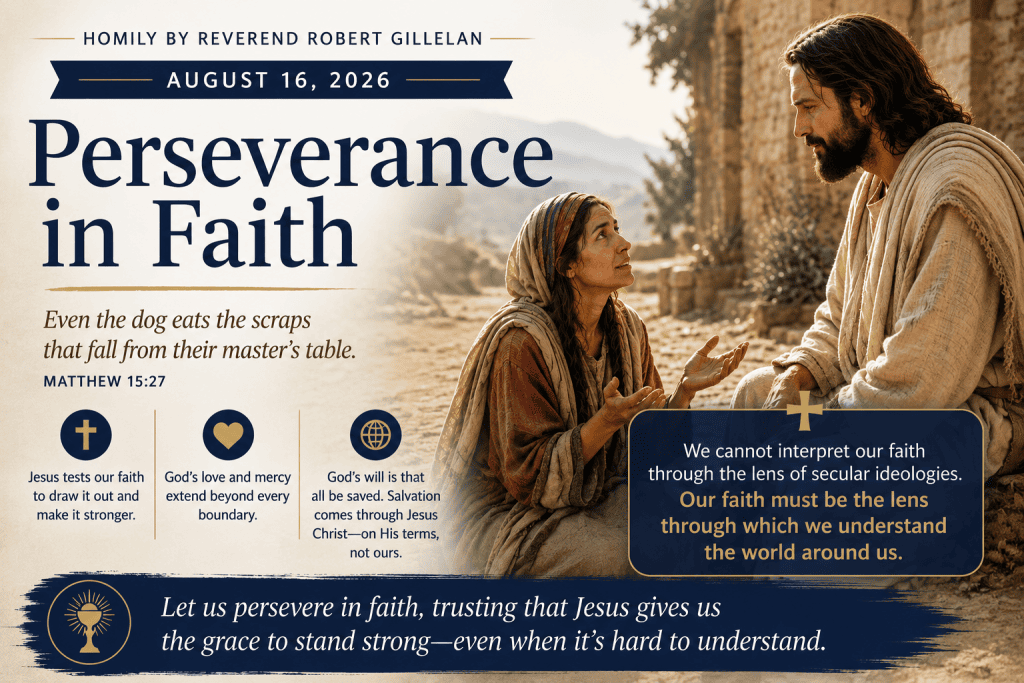
Bishop Robert Barron is possibly the Catholic Church’s most vocal evangelizer. He writes about it, he preaches about it, our faith in relation to our culture. One of the things that he consistently repeats is that we need to understand that we cannot interpret our Catholic faith through the lens of secular ideologies. I think our gospel today is an extraordinary way to show how this is true.
And so, in hearing the gospel, let’s apply a secular ideology from DEI, diversity, equity, and inclusion, and interpret the gospel through that lens. So, first of all, this Canaanite woman who is a pagan approaches Jesus and addresses Him as Lord and the son of David.
So, she is giving expression to some level of faith, and she wants Jesus to help in expelling a demon from her daughter. How does Jesus respond?
He doesn’t say a word. Basically, he ignores this poor woman. Because Jesus ignores this poor woman, now we have to label our Jesus as a racist and sexist. Jesus is a racist, because Jesus is Jewish, and the poor woman is a Canaanite, and He doesn’t help her.
So, Jesus is also a sexist, because He’s a man, but she’s a woman, and Jesus does not help a woman in distress. So, Jesus is already a racist and a sexist.
But the woman doesn’t give up. She has strong faith, and she continues to plead with Jesus to help And what does Jesus say? He says, I have come only from the lost sheep of the house of Israel. That makes Jesus a bigot.
First He’s a racist and a sexist, and now Jesus is a bigot. Because Jesus is Jewish, and she is pagan. And the Jew is not helping the pagan
So now, He’s a bigot on religious grounds.
But the woman, because of her faith continues to press Jesus to help her. And what does Jesus say? He says it’s not right to take the food of the children and throw it to the dogs.
Now he has called this woman a dog. Now he is engaging in hate speech. How can this possibly be? Jesus, a racist a sexist, a bigot and a hater?
Well, Jesus is God and God is love so Jesus is love incarnate walking around on earth. Jesus is not a hater. Jesus is love.
Jesus is none of those labels that a secularist, ideological description would label him. He is none of those things. He is love incarnate, and so what He is doing is, He is loving this woman and drawing faith out of her to the point where this woman gives such an exceptional response. She continues the metaphor, Jesus called her a dog, fine.
Even the dog eat the scraps that fall from their master’s table. Wow.
Such wit and wisdom, such faith. And Jesus loves it, and he says that this woman has great faith. The theological meaning of all this is, you know, she is a Canaanite, and a pagan, but she has shown great faith. So this is Jesus’ extending salvation, the offer of salvation, beyond the boundaries of Judaism.
That’s the big theological picture of this gospel. But I think this speaks to us about perseverance in the faith.
Sometimes Jesus is going to push us. Sometimes Jesus is going to make us work for it.
And we don’t want to roll over and play dead just yet.
Jesus gives us the grace and the faith and the help to stand strong in the face of opposition. Even when it seems to be coming from Jesus himself.
I think also this clearly shows that Bishop Barron is absolutely correct. That we cannot interpret our faith or our spiritual lives through the lens of secular ideologies because they just don’t work.
On the other hand, we as Catholics should be using our faith to interpret secular ideologies, to understand why they do not always work. So today we have this great gospel.
And we have this great advice from Bishop Robert Barron to use the correct tools at our disposal. To understand our faith. And to practice our faith. And to interpret our faith and the gospel and the entire Bible through the lens of the Catholic faith. Let us remember that that faith teaches us that it is God’s will that all be saved. God has a will for universal salvation.
And that salvation comes through Jesus Christ. Let us remember that it comes on His terms not ours.
The Assumption
August 15, 2026
Reverend Robert Gillelan Homily
In celebrating the solemnity of the assumption, we celebrate that at the end of Mary’s life, as the Doctrine says, when her early life was concluded it doesn’t say specifically whether she died or fell asleep, Eastern Catholics call this feast day the dormition indicating that their belief is more that Mary went quietly asleep, and then was assumed, body and soul, into heaven. And that God granted her grace and privilege, without going to the grave, because of her immaculate conception being conceived without sin, then living her life to the life of great holiness. And so, for us, she is this beautiful sign of hope that where Mary has gone from the world, we hope to follow.
As you heard in my reading, this is also our patronal feast day, the Assumption of the Blessed Virgin Mary. It’s in the name of our parish.
Do you know that this is also the anniversary of the consecration of this parish? Sort of.
Because the document in the sacristy right back there, tells us that this church was actually consecrated on August 14th, 1977.
Bishop Daly then mandated that August 15th would be the date we’ll be celebrating the dedication, because it’s the feast of the Assumption. Now, I’m curious, how many of you were here on August 14th, 1977, for the consecration of this church?
I see a few of you were here on August 14th. Well, that was 49 years ago, so….
But, the consecrating a church, what does that mean? It means sanctifying this specific building for the exclusive worship of God.
That is a great new ceremony for those of you who are here and experienced it. A consecration of the church is done by a bishop.
Secondly, it is usually done when the church is debt-free. So, congratulations. In 1977, after just a few years, the church had paid off its mortgage. So, there is no outside encumbrance, no financial institutions or banks or mortgages, so that it is unencumbered and can be dedicated solely to God and the worship of God.
One of the main features of that, when the bishop comes to consecrate the church, is he smears it with prism in 12 places on the walls. You can see, around the church, there are 12 candles that are lit. And it’s custom to light those candles on this feast day.
We also light them at Christmas and Easter. But that’s where, or in the vicinity, where the bishop put prism on the church and consecrated it in that way, symbolic of the foundation of the 12 apostles.
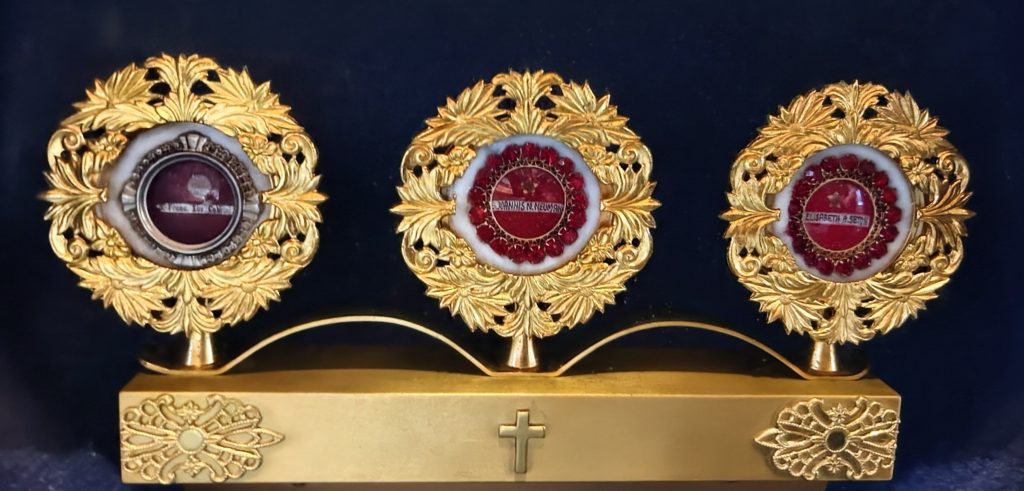
Also, Bishop Daily would have anointed this altar holy chrism. And the relics. Now, in some churches, on the day of consecration, relics are actually placed within the altar.
So, I assume these were pre-placed were probably already in place, or did they come later. So, on that day Deacon believes that these relics were placed in this reliquary in the altar.
This is the first church in the world to have relics of the first three American saints. Saint John Newman, Saint Elizabeth Ann Seton, and Saint Frances Xavier Cabrini. And why?
Why would we do that? Why would we put relics in the altar? Because the ancient Christians used to go to the graves of the saints and worship there.
And at some point in the ceremony, these altar candles were lit as a sign of Christ as a light in the world. So, an altar cloth would have been placed on the altar. The altar itself was anointed, symbolic of the altar being the sign of Christ himself.
And then the altar cloth, the sign of the table of the Lord. The altar being not only the altar of sacrifice, but the banquet of the table, from which we received our sacred body and blood of Jesus Christ.
I think that is most of the highlights of a consecration ceremony, but it is a very, very profound experience to be a part of. And if you say, well, you know, I’ve heard that Catholic churches sometimes get sold.
How can that be? Well, they can be.
They are relegated to profane, but not sordid use. And of course, sordid is in the eye of the beholder. In Steelton , two Catholic churches were sold. One is a Muslim mosque now.
And another one is a Hindu temple. And in Pittsburgh, St. John the Baptist Church is now a micro brewery. And I’ve been there, and the beer vats are in what we call the sanctuary. But that’s only after these churches have been kind of decommissioned. The proper term is relegated to profane, but not sordid use.
But we can let go of those sordid affairs today because we are here to celebrate what God has done for our Blessed Mother and raising her up body and soul to the glory of heaven. And also to give thanks to Almighty God for the gift of this beautiful church that for us is dedicated fully and entirely to the worship of the one true God, His Son and our Lord Jesus Christ, and that we are able to do so in the power of the Holy Spirit. So happy feast day and happy anniversary.